
Sundiata is a very
mystical story that plays on certain tropes that are typical to American modern
film values that are often in Disney movies. Firstly, Sundiata has a familiar family
situation as Cinderella. Despite his love, his father’s death leads to Sundiata
being at the mercy of his evil step-mother and step-brother. The step-mother,
whose son technically had the birthright to the throne, feels slighted by the
Father’s decision to claim Sundiata as the next king. Sundiata embodies certain
elements found in Aladdin as well.
Sundiata has the same “diamond in the rough” label that was tagged onto
Aladdin. While he was still royalty, Sundiata’s inability to speak or walk left
him ridiculed by society. However, the prophecies made by mystical powers show
Sundiata to have an intrinsic goodness of him that will eventually lead him to
success. This intrinsic good nature is shown when the witches are hired to kill
Sundiata by the evil step-mother. However, the witches are unable to work their
magic on anyone who does not have anger in their hard, and is simply too kind.
To prove this, even without knowing, Sundiata helps the witches pick out and
steal his spices rather than become angry and vengeful at their thievery. The
main villain of the story, Sumanguru, is similar to an African version of Jafar,
as he is known for his sorcery and power-hungry mentality, and banishes
Sundiata in order to maintain power. The idea of unchanging destiny that is
present in Hercules is also present
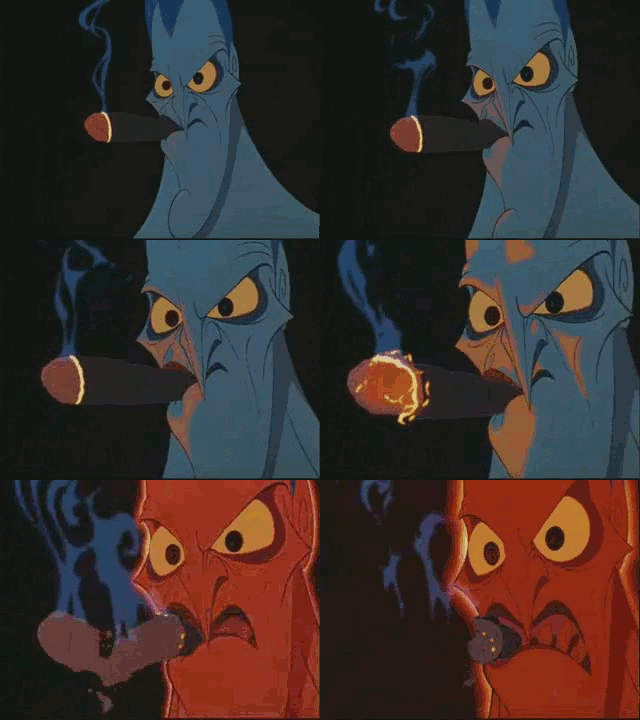
in Sundiata. In Hercules, when Hades
finds out that Hercules will foil his centuries long plan for world domination,
he attempts at every chance to remove Hercules from the picture. He tries to
kill Hercules as a baby, and then when Hades finds out that Hercules survived,
he throws multiple threats such as the Hydra at him, and eventually tries to
use his love of Meg against him.
 However, Hercules is able to persevere through
all of these obstacles and save Olympus and the world as destiny predicted.
This is apparent in Sundiata, as he is foretold to be the future great leader
of Mali. When Sumanguru and his mother do not believe it when Sundiata is
unable to walk or talk, or when they attempt to alter destiny by banishing him
from the kingdom, it all just presents obstacles that are eventually circumvented
by Sundiata to reach his original destiny as the king of Mali. The story even
has some similarities to Disney movies that are more recent, such as Black Panther. Aside from the clothing
of the drawings being similar, the position of “griot” in Sundiata is also present in Black Panther, in Forrest Whitaker’s “Zuri”,
acting as a lifelong advisor that has mystical elements to them. As well, the
idea of being able to challenge for the throne if a person has a birth right is
also present in Black Panther. T’challa’s
story arch is also similar to Sundiata’s, as he is banished after his father dies,
and his familial counterpart, Killmonger, plans to rampage through the world
with his newfound power and military. However, T’challa returns to defeat his
villain. The ending of the main villain is also similar, as rather than submit
to the hero, both Sumanguru and Killmonger choose their own death, although
their motives are different.
However, Hercules is able to persevere through
all of these obstacles and save Olympus and the world as destiny predicted.
This is apparent in Sundiata, as he is foretold to be the future great leader
of Mali. When Sumanguru and his mother do not believe it when Sundiata is
unable to walk or talk, or when they attempt to alter destiny by banishing him
from the kingdom, it all just presents obstacles that are eventually circumvented
by Sundiata to reach his original destiny as the king of Mali. The story even
has some similarities to Disney movies that are more recent, such as Black Panther. Aside from the clothing
of the drawings being similar, the position of “griot” in Sundiata is also present in Black Panther, in Forrest Whitaker’s “Zuri”,
acting as a lifelong advisor that has mystical elements to them. As well, the
idea of being able to challenge for the throne if a person has a birth right is
also present in Black Panther. T’challa’s
story arch is also similar to Sundiata’s, as he is banished after his father dies,
and his familial counterpart, Killmonger, plans to rampage through the world
with his newfound power and military. However, T’challa returns to defeat his
villain. The ending of the main villain is also similar, as rather than submit
to the hero, both Sumanguru and Killmonger choose their own death, although
their motives are different.
No comments:
Post a Comment