Personally, I struggle to decide who made a stronger argument between Morton and Gooding-Williams. In my opinion, both made points that were strong but also had flawed parts to their arguments that make it hard to choose the better argument. According to Morton, Gooding-Williams has two main claims, the first being his depiction of Africa as a history-less continent, and the second being his depiction of the elephant graveyard and its inhabitants as the elephant graveyard. I contend that Morton successfully counters the first point, but fails to fully address the depth of Gooding-Williams' second argument, simply dismissing it as Marxist and arguing that, "every reading of a story is itself a story, complete with mythical dimensions." Of course, Morton extends his argument beyond this, however, it never fully covers its bases, leaving the possibility for Gooding-Williams' to be true.
I find that Gooding-Williams' initial argument that Africa is depicted as historyless is quite problematic, especially given that his argument is that Africa is supposed to be an allegory for Ameria. It doesn't make sense that Williams would argue that Africa is depicted as organic and historyless and then turn to claim that Africa is a depiction for America. Although Morton doesn't use this argument against Gooding-Williams, he still defeats the point in another way by showing how Africa clearly does have a history through the conflict that takes place and by virtue of the circle of life. In particular, he argues, "Indeed, The Lion King's Africa is, I would say, the site of history and ongoing struggle, which is surely why the film ends in exactly the same way it begins ... the recapitulation of the beginning does not simply close the circle: it also suggests that the whole struggle to find a legitimate (and 'good') place in history will be replayed." Although somewhat longwinded, he does manage to get his point across.
Unfortunately, I still find myself swayed with Gooding-Williams' contention that the hyenas, with their voice casting, home, and depiction, represent the inner city and its inhabitants of people of color and of Latinx origin. Morton simply argues that Disney's intention was to create a movie about good vs evil, but his argument leaves many holes through which Williams' could be correct, and thus, it was not an effective counter-argument. Of course, maybe it wasn't Disney's intention to send that message across, however, through careless casting and plot development, it's the message that gets sent across, and as Giroux would argue, when you are an entertainment firm as large as Disney, you have to be more careful with the messages you send. A simple recasting would fix most of the problems.

Monday, April 15, 2019

Morton vs Gooding-Williams Article
After
reading both articles, I thought that Morton’s argument in “Simba’s Revolution:
Revisiting History and Class in The Lion King” was stronger and more effective
about The Lion King (1994). I could
actually see how the “they say” and “I say” component made Morton’s argument
more effective because it was in response to Gooding-Williams’ article “Disney
in Africa and the Inner City: on Race and Space in the Lion King”. In contrast,
the Gooding-Williams article was not in response to another viewpoint, so I
found that overall his article was weaker.
One component that I thought was
stronger in Morton’s argument was regarding history. When I first read
Gooding-Williams argument for this, I thought it was a little weak and I was
not convinced. Especially, when Gooding-Williams says that Africa is “historyless”,
I found that to be a stretch. I think when Morton says that while Africa has
timeless values “that does not mean that the place itself is without history”
(313). I agree with Morton more on this point because to say that a whole contentment
has no history is obviously a very large stretch on Gooding-Williams’ part.
Additionally,
another point that I thought was weak in the Gooding-Williams article was when
Gooding-Williams argued that Scar was a political revolutionary that wanted to
create a utopia, I want not very convinced. There was no evidence that this was
Scar’s intention, so I thought it was a wearer point, and I think that Scar
simply wanted power and didn’t really care what happened when he got that.
Also, when
Morton points out that Gooding-Williams leaves out some information when making
his argument and states that “his focus is skewed towards an incomplete
dialectical reading of the story” (313-314) it makes Gooding-Williams argument
much weaker. I agree that after reading Morton’s argument that I can see how Gooding-Williams
did leave out the sense of struggle from his argument. In my opinion Gooding-Williams’
argument wasn’t that strong to begin with, but after I read Morton’s article it
was even weaker.
Overall,
both articles were interesting to read. I think that they both brought up some
thought provoking ideas, but Gooding-Williams made a few too many stretches
without much evidence. This, in additional to Morton’s article including both
the “they say” and “I say” parts made Morton’s “Simba’s Revolution: Revisiting
History and Class in The Lion King” article much more stronger, effective, and convincing.
Gooding-Williams or Morton
As a
whole, after reading both pieces, I can easily say that the much more thought
out and easily identifiable argument is that of Morton. While Gooding-Williams
and Morton both have interesting points based on their unique perspectives
Morton identifies many of the flaws that I saw in Gooding-Williams's piece. One
of the most convincing aspects of Morton's piece was the fact that he viewed
the entirety of The Lion King rather
than just one part as he points out Gooding-Williams does. Morton examines not
just the imagery related to Scar and the Hyenas but looks at the rest of the
world and the other characters who live there. I was most interested in how he
accomplishes this through his understanding of the relationship between Simba,
Timon, and Pumbaa. Morton discusses the idea that the relationship between the
three characters, something he coins brotherhood, symbolizes the striking of an
alliance between the productive working class (even though Timon and Pumbaa
don’t technically work) and the legitimate ruling class. Another place where I
believe Gooding-Williams fell short that is addressed in Morton's piece is the
lack of an obvious and straight forward interpretation of The Lion King. Not only is the conclusion that
Gooding-Williams comes too much too simple for me to accept as Morton points
out Scar’s world is far from the ideals that Gooding-Williams thrusts upon it,
but the new world is also a place where no one works, everyone is hungry, and
power is corrupt. These aspects do not fit into Gooding-Williams picture of The Lion King as a political allegory and
thusly highlight a major flaw in his argument that The Lion King is much less black and white than Gooding-Williams
accepts. Morton does point out that one of the key themes in the film that is
related to this is the idea that corruption is embedded into the system and not
simply to a particular location. In my mind, this interpretation is much more
believable and much. Better championed by the movie than the argument made by
Gooding-Williams. The final point that I believe emphasized the strength of
Morton's piece was the fact that at multiple points in his piece he pointed out
the ambiguity of interoperating The Lion King.
He states that the film is an empty symbolic vessel. This means that the
understandings of these tales are subject to personal beliefs, and Morton
argues that this makes them stories about stories. The fact that the movie is
up to interpretation means that the various understandings of the work are
themselves stories containing fictional components produced from the
individuals attempting to decode them.
Morton vs Gooding-Williams
I think Morton makes a convincing argument against Gooding-Williams in his essay. By taking note of how Gooding-Williams ignores several components of The Lion King to validate his argument, Morton shows how Gooding-Williams makes invalid arguments in the case of utopia.
Gooding-Williams argues that Disney shows that a utopia which provides equality would not function in society and would ultimately lead to darkness and death. However, to argues this, he claims that Scar is trying to create such a utopia. This is a huge stretch; Morton rightfully discusses how Scar is simply evil. He is not seeking to create a utopia, scar just wants to have power and defeat his brother. Gooding-Williams makes his argument of this dystopia by skewing the plot of the story itself.
Morton discusses how Gooding-WIlliams is a part of the “fetishism of proletarian revolt.” I think this wording is a bit extreme. Gooding-Williams does depict The Lion King as something very reminiscent of the Marxist portrayal in George Orwell’s Animal Farm. However, I think to say he is fetishizing this revolt is a stretch - he is simply drawing an argument based on a limited scope of the plot of The Lion King.
It is also interesting how Morton points out that Gooding-Williams leaves out Timon and Pumbaa from his argument all together, and instead focuses on Rafiki and the Hyenas. Timon and Pumbaa, as Gooding-Williams states, are at the bottom of the food chain yet favor the “capitalist” version of society. However, in discussing how the idea of the circle of life is less destructive than argued by Gooding-Williams, Morton seems to describe Timon and Pumbaa as more insignificant to society than they really are. In my opinion, Timon and Pumbaa could be seen as the unconventional heroes of the story: they are responsible for Simba’s upbringing and ultimately help him take back the throne.
I also agree with Morton that Gooding-Williams does make a valid argument about how The Lion King resembles American inner city life. I think that Gooding-Williams would have had a much stronger argument as a whole if he left out his discussion of Africa and the circle of life and just focused on how the story depicts American inner city life. In doing so, he would have been able to analyze more details in the story relating to American classes, like Timon and Pumba, and would not have made such loose claims regarding the depiction of Africa and of the problematic nature of the circle of life.
Gooding-Williams argues that Disney shows that a utopia which provides equality would not function in society and would ultimately lead to darkness and death. However, to argues this, he claims that Scar is trying to create such a utopia. This is a huge stretch; Morton rightfully discusses how Scar is simply evil. He is not seeking to create a utopia, scar just wants to have power and defeat his brother. Gooding-Williams makes his argument of this dystopia by skewing the plot of the story itself.
Morton discusses how Gooding-WIlliams is a part of the “fetishism of proletarian revolt.” I think this wording is a bit extreme. Gooding-Williams does depict The Lion King as something very reminiscent of the Marxist portrayal in George Orwell’s Animal Farm. However, I think to say he is fetishizing this revolt is a stretch - he is simply drawing an argument based on a limited scope of the plot of The Lion King.
It is also interesting how Morton points out that Gooding-Williams leaves out Timon and Pumbaa from his argument all together, and instead focuses on Rafiki and the Hyenas. Timon and Pumbaa, as Gooding-Williams states, are at the bottom of the food chain yet favor the “capitalist” version of society. However, in discussing how the idea of the circle of life is less destructive than argued by Gooding-Williams, Morton seems to describe Timon and Pumbaa as more insignificant to society than they really are. In my opinion, Timon and Pumbaa could be seen as the unconventional heroes of the story: they are responsible for Simba’s upbringing and ultimately help him take back the throne.
I also agree with Morton that Gooding-Williams does make a valid argument about how The Lion King resembles American inner city life. I think that Gooding-Williams would have had a much stronger argument as a whole if he left out his discussion of Africa and the circle of life and just focused on how the story depicts American inner city life. In doing so, he would have been able to analyze more details in the story relating to American classes, like Timon and Pumba, and would not have made such loose claims regarding the depiction of Africa and of the problematic nature of the circle of life.
Gooding-Williams vs. Morton Papers
After reading Gooding-William’s, I will admit that I did not agree with it very much or did not find it all too convincing. I found the concept of “history” that Gooding-William’s and Morton write so much about to be very confusing. I do not think I fully understand what they meant by the depiction of Africa having history or no history. Nevertheless, I would have to say that I think Gooding-Williams provided the more convincing argument.
First of all, Gooding-Williams provides a clearly stated argument or thesis, which was “By figuring poverty & decline in terms of physical spaces caused by the entry of the hyenas, Disney’s film renders invisible the macropolitical & -economic social relations that reproduce urban poverty.” In addition, Gooding Williams provides provides evidence to support this argument such as quotes and and good analysis of these quotes. In Gooding-Williams’s argument, he quotes Hegel and uses Hegel’s ideas of a “historyless Africa” to support his argument. After quoting Hegel, Good-Williams also immediately addresses the quote and tells readers what they should get from the quote. However, regardless of the fact that Gooding-Williams uses good strategies of providing evidence and then analysis, I did not find this particular argument of a “historyless Africa” and the “circle of life” to be very convincing. Instead, I found it to be confusing and a little too out there to be plausible. In fact, I think his whole argument under the subtitle “Disney in Africa” didn’t really fit in well with his thesis that Disney masks the real conditions that create urban poverty. In contrast, I did find his argument of Disney’s Africa being an “allegory of Disney’s America” to be convincing, therefore I did agree with some of the points Gooding-Williams made under the subtitle “Disney in the Inner City.” Again, Gooding-Williams provides evidence to his argument by quoting the film, analyzing scenes, providing information on the voices behind the characters, and analyzing and comparing the Lion King to other Hollywood films that depict similar images of blacks. For example, Gooding-Williams quotes another reviewer of the Lion King, Janet Malin, and clearly addresses what is right and wrong with her argument in a way that supports his argument. I do believe that his argument that “an essential part of the movie’s allegorical vision is the perfect polity America would be if its circle of life excluded its underclass of black and Latino scavengers” is a plausible and convincing argument that supports his overall thesis.
Morton on the other hand provided a slightly less convincing argument than Gooding-Williams due to his lack of support or evidence. Morton does a good job with addressing the "they say" (or Gooding-Williams says), and then providing the "I say" to each of Gooding-Williams’s points. He is very specific in explaining what was wrong with Gooding-Williams’s argument and then giving a detailed explanation of his argument and the “correct” way to think about the movie. However, unlike Gooding-Williams, Morton provides no evidence to back up his points thus taking away their credibility. In my opinion, Morton would have provided the stronger argument because I found his points in themselves to be more convincing but his lack of support and credibility took away from his argument.
Overall, although Gooding-Williams does not provide a very convincing argument, it is is more well supported then Morton’s argument thus increasing the credibility and strength of the argument.
Sunday, April 14, 2019
Gooding WIlliams vs Morton
Concerning The Lion
King, John Morton makes a much stronger argument than Robert Gooding-Williams.
Williams’ argument suffers from a narrow and biased scope that does not
resonate with a reader who does not hold the same mindset or opinion. In
essence, Williams does not entice a reader to agree with him. Many of Williams’
main issues are highlighted in Morton’s work. Firstly, the claim that “Africa
is historyless” and mainly that Scar is the only form of history on Pride Rock
is not well substantiated. Williams paints Scar almost nobly, as a
revolutionary trying to “enfranchise” the underprivileged in society. Williams then extends this argument as being
almost anti-immigration or anti-class mobility by claiming that the destruction
that comes to Pride Rock as a result of the hyenas is an advocation for
elitism. However, as pointed out by Morton, Williams fails to acknowledge not
only the inherent traits of the hyenas and scar, but also fails to recognize
Timon and Pumbaa. Scar is no working class revolutionary, as he is simply using
the hyenas in order to obtain personal gain and power. Scar is “at the top of the
food chain”, and his goals do not concern the enfranchisement of lowly scavengers.
As well, as Morton points out, the system Scar implements is “equally static
and cyclical as the one it replaced”. Scar did not break the mold of history in
Pride Rock. Instead, he simply redirected it into “a cycle of death”. Timon and
Pumbaa prove to be the main counterargument to Williams’ theory.
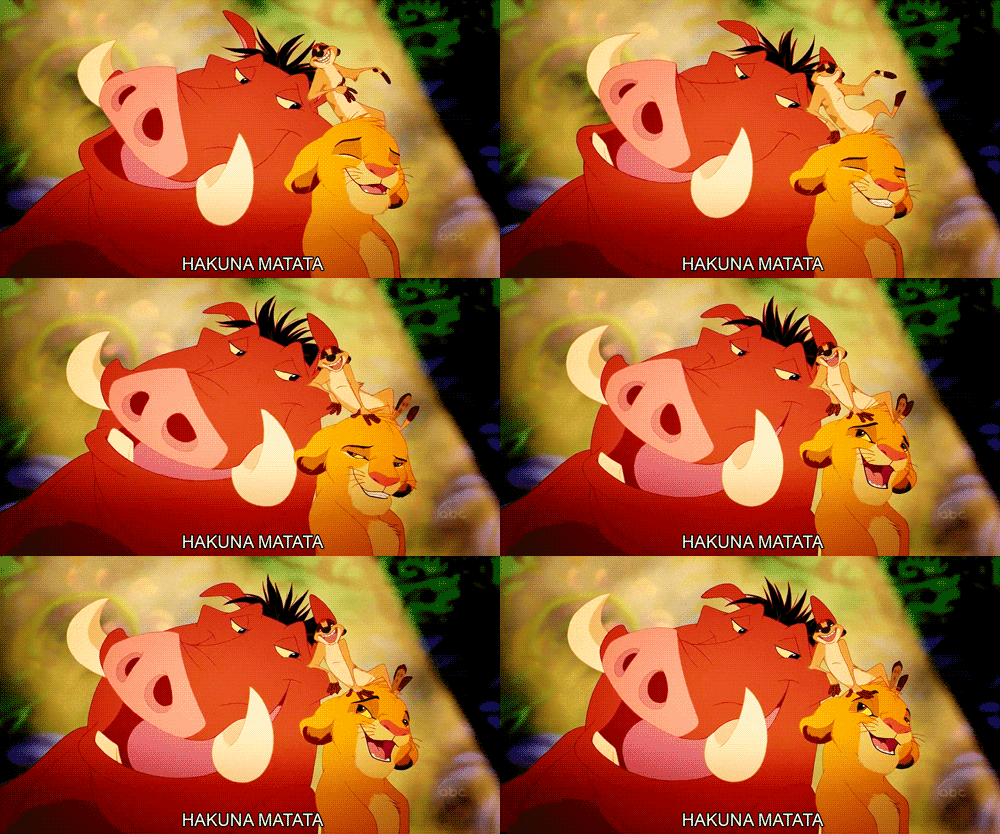
While Williams
points to the hyenas as the sole embodiment of the lower class, and how their
demonization is representative of the view on all of the lower class. However,
Timon and Pumbaa’s relationship with Simba breaks this entire theory. Timon and
Pumbaa are satisfied with their lowly status, and have learned to enjoy the
carefree lifestyle of their lives. Simba’s relationship with the pairing,
however, shows a joining of forces between the upper and lower classes of
society. They learn to appreciate the upsides of both roles and eventually
Timon and Pumbaa step up to assist Simba in regaining his rightful place. This
represents “an alliance between the productive working class and the legitimate
ruling class.” They fight against people that are “scroungers and those who
would seek power for its own sake.” Scar and the hyenas are no noble
proletariat that will rise based on Marxist theory. Instead they are scoundrels
who are selfish and lazy, and lack the means to rise in the world so they rise
through deceit. Lastly, Morton’s paper obviously gets a boost in credibility as
it is serving an easier purpose. As established, disagreeing with a formerly
made point presents less of a challenge than making that original point.
Mussafer Gooding-Williams vs. Morton
When I read Gooding-Williams' article on The Lion King I had many questions. I underlined and highlighted many parts of his writing as there were many claims that he made that seemed rather far fetched for me. I enjoyed reading Morton's article as he had some of the same instances of confusion/suspecion that I had. While Gooding-Williams' article had some big claims, the biggest that The Lion King was an allegory for America, he did provide rather in depth explanations for his claims. While I do not agree with his overall argument of Lion King's connection to the US, there are many parts that were very valid that I agree with. For example, he says that "it is not farfetched to suppose that Disney is playing a major role in the political formation of America's children". Children consume and imitate what they see. Children watch Disney movies, fall in love with the characters, the storys, songs, etc. and so Disney plays a large role in what children see and what they thus perceive. As humans, we connect what we see to how we few our own lives. In this case, children see certain things on tv and they unconsciously connect these instances to society. For example, Disney has received criticism on their portrayal of genders, cultures, socioeconomic status and much more. There is a reason that Disney's Frozen had such a major presence in society. It was a major step for Disney to change their basic format of having the prince save the princess, and fall in love and create the story of Frozen where there two female leads where love is prominent, but it is not the romantic type and is rather the bond between two sisters. I do agree that there is validity to the criticism that Disney received regarding their portrayal of the hyenas in the story as two of the hyenas are voiced by African American people while the major of the "good" characters are voiced by white people. One thing that I highlighted in the article was that Gooding-Williams claims that The Lion King is answering the question of where this place of danger and evil exists. Disney answers this by elluding that it is where the hyenas live. Gooding-Williams says that it is "not somewhere in Africa [but] [r]ather the place in which Simba and Nala lose themselves is in the American inner city. I responded to this by saying that I can't imagine Disney consciously doing this. I do agree that Disney may have chosen the hyena's voices and the location with their idea of society but I do not think they purposely decided to have this place represent the American Inner city.
Morton questions this and argues that Timon and Pumbaa "certainly represent the more benign side of the "lower orders" and that they have validity for being those in the lower class. Morton is not saying that the hyenas could still not represent the lower class but I think Morton is right to bring up this argument about Timon and Pumbaa and they are also represented as being of lower class and race brought up in their depiction of being from this class. Morton goes on to say that "The Lion King strikes an alliance between the productive working class and the legitimate ruling class" and infers that this idea of status in The Lion King may have been less related to racial stereotypes in America's society than Gooding-Williams alluded to.

In Morton's closing remarks he writes "[s]ince we may, in fact, choose to fill The Lion King's empty symbolic vessels with what we will". This line struck me as it felt like a jab at Gooding-Williams' piece as well as everyone who tries to analyze The Lion King as I take it that he is inferring that there may not be actually any symbolize and that people are claiming these conceptions of the movie in areas where Disney may have not intended there to be any symbolize. I disagree with this claim. As a stated earlier, everything that people watch, read, and listen to play a role in their view of their own lives and society. I think that no matter if Disney intended there to be or not, these symbols are still there and so it is hard to say that these allegories do not exist as everything has a deeper meaning whether it is consciously placed there or not. The choices, decisions, and opinions that someone has is based on past events that have influenced them and so whether or not it is conscious, these past events always influence a person's decisions. And so having two of the hyenas being voiced by black artists and having the good characters being voiced by white people are not fully a coincidence. Deep in someone's subconscious they chose those voices for a reason and it is naive to say that there is no deeper meaning for why those decisions were made.
https://screenrant.com/lion-king-remake-hyenas-biggest-change/
Morton questions this and argues that Timon and Pumbaa "certainly represent the more benign side of the "lower orders" and that they have validity for being those in the lower class. Morton is not saying that the hyenas could still not represent the lower class but I think Morton is right to bring up this argument about Timon and Pumbaa and they are also represented as being of lower class and race brought up in their depiction of being from this class. Morton goes on to say that "The Lion King strikes an alliance between the productive working class and the legitimate ruling class" and infers that this idea of status in The Lion King may have been less related to racial stereotypes in America's society than Gooding-Williams alluded to.

In Morton's closing remarks he writes "[s]ince we may, in fact, choose to fill The Lion King's empty symbolic vessels with what we will". This line struck me as it felt like a jab at Gooding-Williams' piece as well as everyone who tries to analyze The Lion King as I take it that he is inferring that there may not be actually any symbolize and that people are claiming these conceptions of the movie in areas where Disney may have not intended there to be any symbolize. I disagree with this claim. As a stated earlier, everything that people watch, read, and listen to play a role in their view of their own lives and society. I think that no matter if Disney intended there to be or not, these symbols are still there and so it is hard to say that these allegories do not exist as everything has a deeper meaning whether it is consciously placed there or not. The choices, decisions, and opinions that someone has is based on past events that have influenced them and so whether or not it is conscious, these past events always influence a person's decisions. And so having two of the hyenas being voiced by black artists and having the good characters being voiced by white people are not fully a coincidence. Deep in someone's subconscious they chose those voices for a reason and it is naive to say that there is no deeper meaning for why those decisions were made.
https://screenrant.com/lion-king-remake-hyenas-biggest-change/
Subscribe to:
Posts (Atom)