Personally, I struggle to decide who made a stronger argument between Morton and Gooding-Williams. In my opinion, both made points that were strong but also had flawed parts to their arguments that make it hard to choose the better argument. According to Morton, Gooding-Williams has two main claims, the first being his depiction of Africa as a history-less continent, and the second being his depiction of the elephant graveyard and its inhabitants as the elephant graveyard. I contend that Morton successfully counters the first point, but fails to fully address the depth of Gooding-Williams' second argument, simply dismissing it as Marxist and arguing that, "every reading of a story is itself a story, complete with mythical dimensions." Of course, Morton extends his argument beyond this, however, it never fully covers its bases, leaving the possibility for Gooding-Williams' to be true.
I find that Gooding-Williams' initial argument that Africa is depicted as historyless is quite problematic, especially given that his argument is that Africa is supposed to be an allegory for Ameria. It doesn't make sense that Williams would argue that Africa is depicted as organic and historyless and then turn to claim that Africa is a depiction for America. Although Morton doesn't use this argument against Gooding-Williams, he still defeats the point in another way by showing how Africa clearly does have a history through the conflict that takes place and by virtue of the circle of life. In particular, he argues, "Indeed, The Lion King's Africa is, I would say, the site of history and ongoing struggle, which is surely why the film ends in exactly the same way it begins ... the recapitulation of the beginning does not simply close the circle: it also suggests that the whole struggle to find a legitimate (and 'good') place in history will be replayed." Although somewhat longwinded, he does manage to get his point across.
Unfortunately, I still find myself swayed with Gooding-Williams' contention that the hyenas, with their voice casting, home, and depiction, represent the inner city and its inhabitants of people of color and of Latinx origin. Morton simply argues that Disney's intention was to create a movie about good vs evil, but his argument leaves many holes through which Williams' could be correct, and thus, it was not an effective counter-argument. Of course, maybe it wasn't Disney's intention to send that message across, however, through careless casting and plot development, it's the message that gets sent across, and as Giroux would argue, when you are an entertainment firm as large as Disney, you have to be more careful with the messages you send. A simple recasting would fix most of the problems.

Monday, April 15, 2019

Morton vs Gooding-Williams Article
After
reading both articles, I thought that Morton’s argument in “Simba’s Revolution:
Revisiting History and Class in The Lion King” was stronger and more effective
about The Lion King (1994). I could
actually see how the “they say” and “I say” component made Morton’s argument
more effective because it was in response to Gooding-Williams’ article “Disney
in Africa and the Inner City: on Race and Space in the Lion King”. In contrast,
the Gooding-Williams article was not in response to another viewpoint, so I
found that overall his article was weaker.
One component that I thought was
stronger in Morton’s argument was regarding history. When I first read
Gooding-Williams argument for this, I thought it was a little weak and I was
not convinced. Especially, when Gooding-Williams says that Africa is “historyless”,
I found that to be a stretch. I think when Morton says that while Africa has
timeless values “that does not mean that the place itself is without history”
(313). I agree with Morton more on this point because to say that a whole contentment
has no history is obviously a very large stretch on Gooding-Williams’ part.
Additionally,
another point that I thought was weak in the Gooding-Williams article was when
Gooding-Williams argued that Scar was a political revolutionary that wanted to
create a utopia, I want not very convinced. There was no evidence that this was
Scar’s intention, so I thought it was a wearer point, and I think that Scar
simply wanted power and didn’t really care what happened when he got that.
Also, when
Morton points out that Gooding-Williams leaves out some information when making
his argument and states that “his focus is skewed towards an incomplete
dialectical reading of the story” (313-314) it makes Gooding-Williams argument
much weaker. I agree that after reading Morton’s argument that I can see how Gooding-Williams
did leave out the sense of struggle from his argument. In my opinion Gooding-Williams’
argument wasn’t that strong to begin with, but after I read Morton’s article it
was even weaker.
Overall,
both articles were interesting to read. I think that they both brought up some
thought provoking ideas, but Gooding-Williams made a few too many stretches
without much evidence. This, in additional to Morton’s article including both
the “they say” and “I say” parts made Morton’s “Simba’s Revolution: Revisiting
History and Class in The Lion King” article much more stronger, effective, and convincing.
Gooding-Williams or Morton
As a
whole, after reading both pieces, I can easily say that the much more thought
out and easily identifiable argument is that of Morton. While Gooding-Williams
and Morton both have interesting points based on their unique perspectives
Morton identifies many of the flaws that I saw in Gooding-Williams's piece. One
of the most convincing aspects of Morton's piece was the fact that he viewed
the entirety of The Lion King rather
than just one part as he points out Gooding-Williams does. Morton examines not
just the imagery related to Scar and the Hyenas but looks at the rest of the
world and the other characters who live there. I was most interested in how he
accomplishes this through his understanding of the relationship between Simba,
Timon, and Pumbaa. Morton discusses the idea that the relationship between the
three characters, something he coins brotherhood, symbolizes the striking of an
alliance between the productive working class (even though Timon and Pumbaa
don’t technically work) and the legitimate ruling class. Another place where I
believe Gooding-Williams fell short that is addressed in Morton's piece is the
lack of an obvious and straight forward interpretation of The Lion King. Not only is the conclusion that
Gooding-Williams comes too much too simple for me to accept as Morton points
out Scar’s world is far from the ideals that Gooding-Williams thrusts upon it,
but the new world is also a place where no one works, everyone is hungry, and
power is corrupt. These aspects do not fit into Gooding-Williams picture of The Lion King as a political allegory and
thusly highlight a major flaw in his argument that The Lion King is much less black and white than Gooding-Williams
accepts. Morton does point out that one of the key themes in the film that is
related to this is the idea that corruption is embedded into the system and not
simply to a particular location. In my mind, this interpretation is much more
believable and much. Better championed by the movie than the argument made by
Gooding-Williams. The final point that I believe emphasized the strength of
Morton's piece was the fact that at multiple points in his piece he pointed out
the ambiguity of interoperating The Lion King.
He states that the film is an empty symbolic vessel. This means that the
understandings of these tales are subject to personal beliefs, and Morton
argues that this makes them stories about stories. The fact that the movie is
up to interpretation means that the various understandings of the work are
themselves stories containing fictional components produced from the
individuals attempting to decode them.
Morton vs Gooding-Williams
I think Morton makes a convincing argument against Gooding-Williams in his essay. By taking note of how Gooding-Williams ignores several components of The Lion King to validate his argument, Morton shows how Gooding-Williams makes invalid arguments in the case of utopia.
Gooding-Williams argues that Disney shows that a utopia which provides equality would not function in society and would ultimately lead to darkness and death. However, to argues this, he claims that Scar is trying to create such a utopia. This is a huge stretch; Morton rightfully discusses how Scar is simply evil. He is not seeking to create a utopia, scar just wants to have power and defeat his brother. Gooding-Williams makes his argument of this dystopia by skewing the plot of the story itself.
Morton discusses how Gooding-WIlliams is a part of the “fetishism of proletarian revolt.” I think this wording is a bit extreme. Gooding-Williams does depict The Lion King as something very reminiscent of the Marxist portrayal in George Orwell’s Animal Farm. However, I think to say he is fetishizing this revolt is a stretch - he is simply drawing an argument based on a limited scope of the plot of The Lion King.
It is also interesting how Morton points out that Gooding-Williams leaves out Timon and Pumbaa from his argument all together, and instead focuses on Rafiki and the Hyenas. Timon and Pumbaa, as Gooding-Williams states, are at the bottom of the food chain yet favor the “capitalist” version of society. However, in discussing how the idea of the circle of life is less destructive than argued by Gooding-Williams, Morton seems to describe Timon and Pumbaa as more insignificant to society than they really are. In my opinion, Timon and Pumbaa could be seen as the unconventional heroes of the story: they are responsible for Simba’s upbringing and ultimately help him take back the throne.
I also agree with Morton that Gooding-Williams does make a valid argument about how The Lion King resembles American inner city life. I think that Gooding-Williams would have had a much stronger argument as a whole if he left out his discussion of Africa and the circle of life and just focused on how the story depicts American inner city life. In doing so, he would have been able to analyze more details in the story relating to American classes, like Timon and Pumba, and would not have made such loose claims regarding the depiction of Africa and of the problematic nature of the circle of life.
Gooding-Williams argues that Disney shows that a utopia which provides equality would not function in society and would ultimately lead to darkness and death. However, to argues this, he claims that Scar is trying to create such a utopia. This is a huge stretch; Morton rightfully discusses how Scar is simply evil. He is not seeking to create a utopia, scar just wants to have power and defeat his brother. Gooding-Williams makes his argument of this dystopia by skewing the plot of the story itself.
Morton discusses how Gooding-WIlliams is a part of the “fetishism of proletarian revolt.” I think this wording is a bit extreme. Gooding-Williams does depict The Lion King as something very reminiscent of the Marxist portrayal in George Orwell’s Animal Farm. However, I think to say he is fetishizing this revolt is a stretch - he is simply drawing an argument based on a limited scope of the plot of The Lion King.
It is also interesting how Morton points out that Gooding-Williams leaves out Timon and Pumbaa from his argument all together, and instead focuses on Rafiki and the Hyenas. Timon and Pumbaa, as Gooding-Williams states, are at the bottom of the food chain yet favor the “capitalist” version of society. However, in discussing how the idea of the circle of life is less destructive than argued by Gooding-Williams, Morton seems to describe Timon and Pumbaa as more insignificant to society than they really are. In my opinion, Timon and Pumbaa could be seen as the unconventional heroes of the story: they are responsible for Simba’s upbringing and ultimately help him take back the throne.
I also agree with Morton that Gooding-Williams does make a valid argument about how The Lion King resembles American inner city life. I think that Gooding-Williams would have had a much stronger argument as a whole if he left out his discussion of Africa and the circle of life and just focused on how the story depicts American inner city life. In doing so, he would have been able to analyze more details in the story relating to American classes, like Timon and Pumba, and would not have made such loose claims regarding the depiction of Africa and of the problematic nature of the circle of life.
Gooding-Williams vs. Morton Papers
After reading Gooding-William’s, I will admit that I did not agree with it very much or did not find it all too convincing. I found the concept of “history” that Gooding-William’s and Morton write so much about to be very confusing. I do not think I fully understand what they meant by the depiction of Africa having history or no history. Nevertheless, I would have to say that I think Gooding-Williams provided the more convincing argument.
First of all, Gooding-Williams provides a clearly stated argument or thesis, which was “By figuring poverty & decline in terms of physical spaces caused by the entry of the hyenas, Disney’s film renders invisible the macropolitical & -economic social relations that reproduce urban poverty.” In addition, Gooding Williams provides provides evidence to support this argument such as quotes and and good analysis of these quotes. In Gooding-Williams’s argument, he quotes Hegel and uses Hegel’s ideas of a “historyless Africa” to support his argument. After quoting Hegel, Good-Williams also immediately addresses the quote and tells readers what they should get from the quote. However, regardless of the fact that Gooding-Williams uses good strategies of providing evidence and then analysis, I did not find this particular argument of a “historyless Africa” and the “circle of life” to be very convincing. Instead, I found it to be confusing and a little too out there to be plausible. In fact, I think his whole argument under the subtitle “Disney in Africa” didn’t really fit in well with his thesis that Disney masks the real conditions that create urban poverty. In contrast, I did find his argument of Disney’s Africa being an “allegory of Disney’s America” to be convincing, therefore I did agree with some of the points Gooding-Williams made under the subtitle “Disney in the Inner City.” Again, Gooding-Williams provides evidence to his argument by quoting the film, analyzing scenes, providing information on the voices behind the characters, and analyzing and comparing the Lion King to other Hollywood films that depict similar images of blacks. For example, Gooding-Williams quotes another reviewer of the Lion King, Janet Malin, and clearly addresses what is right and wrong with her argument in a way that supports his argument. I do believe that his argument that “an essential part of the movie’s allegorical vision is the perfect polity America would be if its circle of life excluded its underclass of black and Latino scavengers” is a plausible and convincing argument that supports his overall thesis.
Morton on the other hand provided a slightly less convincing argument than Gooding-Williams due to his lack of support or evidence. Morton does a good job with addressing the "they say" (or Gooding-Williams says), and then providing the "I say" to each of Gooding-Williams’s points. He is very specific in explaining what was wrong with Gooding-Williams’s argument and then giving a detailed explanation of his argument and the “correct” way to think about the movie. However, unlike Gooding-Williams, Morton provides no evidence to back up his points thus taking away their credibility. In my opinion, Morton would have provided the stronger argument because I found his points in themselves to be more convincing but his lack of support and credibility took away from his argument.
Overall, although Gooding-Williams does not provide a very convincing argument, it is is more well supported then Morton’s argument thus increasing the credibility and strength of the argument.
Sunday, April 14, 2019
Gooding WIlliams vs Morton
Concerning The Lion
King, John Morton makes a much stronger argument than Robert Gooding-Williams.
Williams’ argument suffers from a narrow and biased scope that does not
resonate with a reader who does not hold the same mindset or opinion. In
essence, Williams does not entice a reader to agree with him. Many of Williams’
main issues are highlighted in Morton’s work. Firstly, the claim that “Africa
is historyless” and mainly that Scar is the only form of history on Pride Rock
is not well substantiated. Williams paints Scar almost nobly, as a
revolutionary trying to “enfranchise” the underprivileged in society. Williams then extends this argument as being
almost anti-immigration or anti-class mobility by claiming that the destruction
that comes to Pride Rock as a result of the hyenas is an advocation for
elitism. However, as pointed out by Morton, Williams fails to acknowledge not
only the inherent traits of the hyenas and scar, but also fails to recognize
Timon and Pumbaa. Scar is no working class revolutionary, as he is simply using
the hyenas in order to obtain personal gain and power. Scar is “at the top of the
food chain”, and his goals do not concern the enfranchisement of lowly scavengers.
As well, as Morton points out, the system Scar implements is “equally static
and cyclical as the one it replaced”. Scar did not break the mold of history in
Pride Rock. Instead, he simply redirected it into “a cycle of death”. Timon and
Pumbaa prove to be the main counterargument to Williams’ theory.
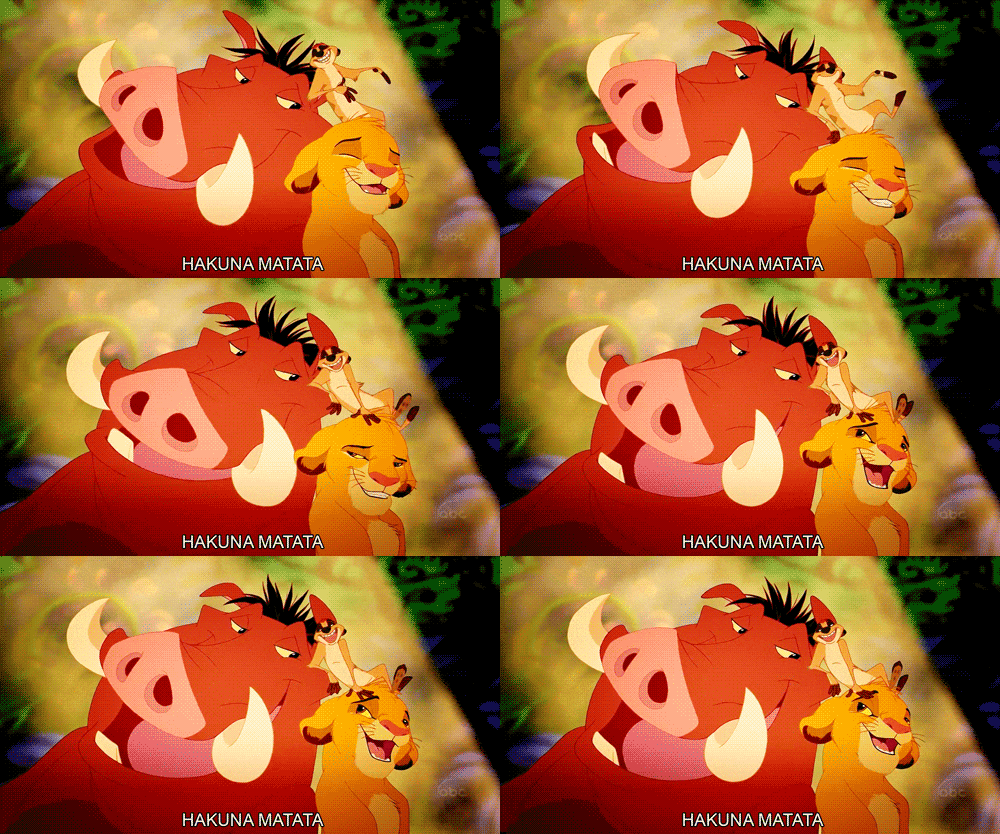
While Williams
points to the hyenas as the sole embodiment of the lower class, and how their
demonization is representative of the view on all of the lower class. However,
Timon and Pumbaa’s relationship with Simba breaks this entire theory. Timon and
Pumbaa are satisfied with their lowly status, and have learned to enjoy the
carefree lifestyle of their lives. Simba’s relationship with the pairing,
however, shows a joining of forces between the upper and lower classes of
society. They learn to appreciate the upsides of both roles and eventually
Timon and Pumbaa step up to assist Simba in regaining his rightful place. This
represents “an alliance between the productive working class and the legitimate
ruling class.” They fight against people that are “scroungers and those who
would seek power for its own sake.” Scar and the hyenas are no noble
proletariat that will rise based on Marxist theory. Instead they are scoundrels
who are selfish and lazy, and lack the means to rise in the world so they rise
through deceit. Lastly, Morton’s paper obviously gets a boost in credibility as
it is serving an easier purpose. As established, disagreeing with a formerly
made point presents less of a challenge than making that original point.
Mussafer Gooding-Williams vs. Morton
When I read Gooding-Williams' article on The Lion King I had many questions. I underlined and highlighted many parts of his writing as there were many claims that he made that seemed rather far fetched for me. I enjoyed reading Morton's article as he had some of the same instances of confusion/suspecion that I had. While Gooding-Williams' article had some big claims, the biggest that The Lion King was an allegory for America, he did provide rather in depth explanations for his claims. While I do not agree with his overall argument of Lion King's connection to the US, there are many parts that were very valid that I agree with. For example, he says that "it is not farfetched to suppose that Disney is playing a major role in the political formation of America's children". Children consume and imitate what they see. Children watch Disney movies, fall in love with the characters, the storys, songs, etc. and so Disney plays a large role in what children see and what they thus perceive. As humans, we connect what we see to how we few our own lives. In this case, children see certain things on tv and they unconsciously connect these instances to society. For example, Disney has received criticism on their portrayal of genders, cultures, socioeconomic status and much more. There is a reason that Disney's Frozen had such a major presence in society. It was a major step for Disney to change their basic format of having the prince save the princess, and fall in love and create the story of Frozen where there two female leads where love is prominent, but it is not the romantic type and is rather the bond between two sisters. I do agree that there is validity to the criticism that Disney received regarding their portrayal of the hyenas in the story as two of the hyenas are voiced by African American people while the major of the "good" characters are voiced by white people. One thing that I highlighted in the article was that Gooding-Williams claims that The Lion King is answering the question of where this place of danger and evil exists. Disney answers this by elluding that it is where the hyenas live. Gooding-Williams says that it is "not somewhere in Africa [but] [r]ather the place in which Simba and Nala lose themselves is in the American inner city. I responded to this by saying that I can't imagine Disney consciously doing this. I do agree that Disney may have chosen the hyena's voices and the location with their idea of society but I do not think they purposely decided to have this place represent the American Inner city.
Morton questions this and argues that Timon and Pumbaa "certainly represent the more benign side of the "lower orders" and that they have validity for being those in the lower class. Morton is not saying that the hyenas could still not represent the lower class but I think Morton is right to bring up this argument about Timon and Pumbaa and they are also represented as being of lower class and race brought up in their depiction of being from this class. Morton goes on to say that "The Lion King strikes an alliance between the productive working class and the legitimate ruling class" and infers that this idea of status in The Lion King may have been less related to racial stereotypes in America's society than Gooding-Williams alluded to.

In Morton's closing remarks he writes "[s]ince we may, in fact, choose to fill The Lion King's empty symbolic vessels with what we will". This line struck me as it felt like a jab at Gooding-Williams' piece as well as everyone who tries to analyze The Lion King as I take it that he is inferring that there may not be actually any symbolize and that people are claiming these conceptions of the movie in areas where Disney may have not intended there to be any symbolize. I disagree with this claim. As a stated earlier, everything that people watch, read, and listen to play a role in their view of their own lives and society. I think that no matter if Disney intended there to be or not, these symbols are still there and so it is hard to say that these allegories do not exist as everything has a deeper meaning whether it is consciously placed there or not. The choices, decisions, and opinions that someone has is based on past events that have influenced them and so whether or not it is conscious, these past events always influence a person's decisions. And so having two of the hyenas being voiced by black artists and having the good characters being voiced by white people are not fully a coincidence. Deep in someone's subconscious they chose those voices for a reason and it is naive to say that there is no deeper meaning for why those decisions were made.
https://screenrant.com/lion-king-remake-hyenas-biggest-change/
Morton questions this and argues that Timon and Pumbaa "certainly represent the more benign side of the "lower orders" and that they have validity for being those in the lower class. Morton is not saying that the hyenas could still not represent the lower class but I think Morton is right to bring up this argument about Timon and Pumbaa and they are also represented as being of lower class and race brought up in their depiction of being from this class. Morton goes on to say that "The Lion King strikes an alliance between the productive working class and the legitimate ruling class" and infers that this idea of status in The Lion King may have been less related to racial stereotypes in America's society than Gooding-Williams alluded to.

In Morton's closing remarks he writes "[s]ince we may, in fact, choose to fill The Lion King's empty symbolic vessels with what we will". This line struck me as it felt like a jab at Gooding-Williams' piece as well as everyone who tries to analyze The Lion King as I take it that he is inferring that there may not be actually any symbolize and that people are claiming these conceptions of the movie in areas where Disney may have not intended there to be any symbolize. I disagree with this claim. As a stated earlier, everything that people watch, read, and listen to play a role in their view of their own lives and society. I think that no matter if Disney intended there to be or not, these symbols are still there and so it is hard to say that these allegories do not exist as everything has a deeper meaning whether it is consciously placed there or not. The choices, decisions, and opinions that someone has is based on past events that have influenced them and so whether or not it is conscious, these past events always influence a person's decisions. And so having two of the hyenas being voiced by black artists and having the good characters being voiced by white people are not fully a coincidence. Deep in someone's subconscious they chose those voices for a reason and it is naive to say that there is no deeper meaning for why those decisions were made.
https://screenrant.com/lion-king-remake-hyenas-biggest-change/
Gooding-Williams vs Morton Blog Post

When contemplating both arguments by Robert Gooding-Willliams and John Morton, it is easy to understand that both are broadly on the topic of the whimsical animated Disney feature The Lion King. Gooding-Williams, focuses more on the ramifications of the social class issues that are obvious throughout the film, and how it will affect the future generations political values. On the other hand Morton is also discussing his views on this scenario, but is directly addressing to numerous points in Gooding-Williams’s argument. However, it is quite clear that Morton creates a clearer and more convincing argument overall than that of Gooding- Williams, through various aspects of the paper.
One of the largest issues that stuck out to me when first reading Gooding-Williams’s Disney in Africa and the Inner City: On Race and Space in The Lion King was that the writing style was not clear. Some portions of the paper seem to be poorly organized such as the stingy usage of evidence, or the shallow interpretations of the block quotes that were offered as said evidence. His strangely arranged paper is at odds with the million dollar words/phrases (going as far as to throw a common french phrase in there “raison d’etre” or reason of being) that are thrown into the sentences that distract the reader from his claims, as they struggle to discern what is being said. Overall, Goding-Williams’s assertions also seem a bit far fetched in places, and it also does not address some questions, like why the topic of space in The Lion King matters enough to be placed in the title. To further cement this confusion, there seems to not be a clear conclusion, even though there is a portion titled “Conclusion,” and he does not further address the ‘so what’ of the topic. Why does this matter? This all leads to an unconvincing discussion.
In contrast, Morton’s Simba’s Revolution: Revisiting History and Class in The Lion King does an excellent job at the organization of his paper, having a clear road map addressing the claims brought up in Gooding-Williams’s paper. His writing style provides a clearer understanding of his argument without using language that is exceedingly difficult to understand. He also fully explains his understanding of each piece of evidence, and how it relates to his topic. This provides the readers with the necessary information that allows them to make an informed decision on the topic. Although he does not title a particular section ‘Conclusion,’ Morton provided a distinct concluding portion, that addressed why he considers this argument to be relevant to us nowadays, and reiterates his earlier statement on his opinion of Gooding-Williams’s paper. This altogether creates a more effective assertion of his opinions.
Due to these numerous reasons, Morton's paper provides the readers with a more convincing argument with its well thought out claims and clear layout. Therefore, clearly an easier read than disorganized paper by Gooding-Williams that Morton addresses.

John Morton v. Robert Gooding-Williams
After having read the arguments of Robert Gooding-Williams and John Morton about Disney's The Lion King (1994), I have come to the conclusion that neither of them make use of evidence particularly well. For instance, in Gooding-Williams' article from Social Identities in 1995, titled "Disney in Africa and the Inner City: On Race and Space in The Lion King", he introduces arguably his most important pieces of evidence in his conclusion section -- where it could have been significantly more effective had it been suggested earlier. Nevertheless, even though he may use some of his evidence improperly, Gooding-Williams does seem to have a stronger argument largely due to the quality and quantity of his evidence -- especially his secondary sources -- when compared to John Morton.
Although I believe that Morton has strong ideas, he seems to draw many conclusions and not support his them in the same way that Gooding-Williams does. For example, with respect to the claim that Disney's Africa is "historyless", and its refutation, Gooding-Williams' argument is far better developed than his counterpart's (Gooding-Williams 2). Whereas Gooding-Williams provides evidence from Hegel, history, and the movie, Morton relies almost exclusively on his own interpretation of the movie. In his article, Gooding-Williams supports his claim that the "Africa" found in the Lion King is no different than a typical European view of Africa -- that it is a place that is "historyless ... because it is steeped in the spiritually static and essentially unchanging conditions of 'mere nature'" -- using a quote from Hegel (374). Conversely, in "Simba's Revolution: Revisiting History and Class in The Lion King", a 2010 article from Social Identities, Morton suggests that the Africa depicted is not "without history," in fact it "is almost explicit about the work that must be done to maintain" certain values. While I do appreciate the logic used by Morton in his article, I do not think it quite holds up in comparison to Gooding-Williams' argument as a whole. This idea is strengthened by the is a sense of credibility that I attribute to Gooding-Williams, because he suggests that Disney may be taking the view of Richard Hakluyt, that "transformation and becoming historical... leads to spiritual loss and decline" (375). Thus, Gooding-Williams provides even more evidence for his claim through the ideas of Hakluyt. He argues that the depiction of Africa as historyless actually attributes a sense of spirituality to it -- a spirituality that falls apart when Scar "thinks historically" (375). In addition to suggesting that Disney's feelings on Africa could be based on historical perceptions of the continent, Gooding-Williams' evidence also seems to combat Morton's claim. After considering this portion of Gooding-Williams' argument, Disney could certainly hope to relay the message the "timeless values" ought to be "maintained in time", while still portraying Africa as a historyless land. In short, even though Morton does provide a logical argument against Gooding-Williams's claim, he fails to support his argument in a way necessary to convince me of his ideas.

Additionally, in the second piece of his refutation, Morton takes a similar approach, only providing primary evidence from the movie and his own interpretations. In order to begin my discussion on this refutation, I first feel it necessary to summarize the argument of Gooding-Williams. In comparing the characters of color in the movie to the two types of black characters from The Birth of a Nation (1915), Gooding-Williams effectively claims that "The Lion King is an argument for an American apartheid" (377). The strength of his argument, is predicated on his discussion on the only two groups of characters who are represented as people/animals of color. To him, whereas Rafiki is a subservient person of color who works to maintain the peace, the hyenas represent catalysts for change -- which ultimately results in the pollution of society. Morton, on the other hand, seems to fail to refute these arguments, and he claims that they are not comprehensive. In fact, Morton seems to misinterpret his counterpart's claims -- or at least twist them in a convenient way. For example, Morton writes, "Rafiki, as Mufasa's spiritual 'other' and apparent godfather to Simba, displays less 'fellowship' with the hyenas than Simba's helpful friends, the meerkat, Timon, and the warthog, Pumbaa" (314). He then argues that there is a "a series of oppositions between good and evil ... pervades the whole fabric of the story" (314). While agree with Morton in that Gooding-Williams' discussion of social relations in the movie is somewhat short, I feel that Morton does not recognize the racial component of the discussion. He simply focuses on social dynamics, especially in his quote, which are largely undiscussed in Gooding-Williams' paper. Furthermore, he again fails to make use of secondary sources, which would bolster his claims significantly. Gooding-Williams, however, makes use of all the evidence that is present within the movie to make a strong claim, which he backs up with secondary evidence.
Although I believe that Morton has strong ideas, he seems to draw many conclusions and not support his them in the same way that Gooding-Williams does. For example, with respect to the claim that Disney's Africa is "historyless", and its refutation, Gooding-Williams' argument is far better developed than his counterpart's (Gooding-Williams 2). Whereas Gooding-Williams provides evidence from Hegel, history, and the movie, Morton relies almost exclusively on his own interpretation of the movie. In his article, Gooding-Williams supports his claim that the "Africa" found in the Lion King is no different than a typical European view of Africa -- that it is a place that is "historyless ... because it is steeped in the spiritually static and essentially unchanging conditions of 'mere nature'" -- using a quote from Hegel (374). Conversely, in "Simba's Revolution: Revisiting History and Class in The Lion King", a 2010 article from Social Identities, Morton suggests that the Africa depicted is not "without history," in fact it "is almost explicit about the work that must be done to maintain" certain values. While I do appreciate the logic used by Morton in his article, I do not think it quite holds up in comparison to Gooding-Williams' argument as a whole. This idea is strengthened by the is a sense of credibility that I attribute to Gooding-Williams, because he suggests that Disney may be taking the view of Richard Hakluyt, that "transformation and becoming historical... leads to spiritual loss and decline" (375). Thus, Gooding-Williams provides even more evidence for his claim through the ideas of Hakluyt. He argues that the depiction of Africa as historyless actually attributes a sense of spirituality to it -- a spirituality that falls apart when Scar "thinks historically" (375). In addition to suggesting that Disney's feelings on Africa could be based on historical perceptions of the continent, Gooding-Williams' evidence also seems to combat Morton's claim. After considering this portion of Gooding-Williams' argument, Disney could certainly hope to relay the message the "timeless values" ought to be "maintained in time", while still portraying Africa as a historyless land. In short, even though Morton does provide a logical argument against Gooding-Williams's claim, he fails to support his argument in a way necessary to convince me of his ideas.

Additionally, in the second piece of his refutation, Morton takes a similar approach, only providing primary evidence from the movie and his own interpretations. In order to begin my discussion on this refutation, I first feel it necessary to summarize the argument of Gooding-Williams. In comparing the characters of color in the movie to the two types of black characters from The Birth of a Nation (1915), Gooding-Williams effectively claims that "The Lion King is an argument for an American apartheid" (377). The strength of his argument, is predicated on his discussion on the only two groups of characters who are represented as people/animals of color. To him, whereas Rafiki is a subservient person of color who works to maintain the peace, the hyenas represent catalysts for change -- which ultimately results in the pollution of society. Morton, on the other hand, seems to fail to refute these arguments, and he claims that they are not comprehensive. In fact, Morton seems to misinterpret his counterpart's claims -- or at least twist them in a convenient way. For example, Morton writes, "Rafiki, as Mufasa's spiritual 'other' and apparent godfather to Simba, displays less 'fellowship' with the hyenas than Simba's helpful friends, the meerkat, Timon, and the warthog, Pumbaa" (314). He then argues that there is a "a series of oppositions between good and evil ... pervades the whole fabric of the story" (314). While agree with Morton in that Gooding-Williams' discussion of social relations in the movie is somewhat short, I feel that Morton does not recognize the racial component of the discussion. He simply focuses on social dynamics, especially in his quote, which are largely undiscussed in Gooding-Williams' paper. Furthermore, he again fails to make use of secondary sources, which would bolster his claims significantly. Gooding-Williams, however, makes use of all the evidence that is present within the movie to make a strong claim, which he backs up with secondary evidence.
Morton vs. Gooding-Williams
I found
both John Morton’s and Robert Gooding-Williams’s articles to be well-written, thought-provoking
pieces analyzing The Lion King and its
representation/message of class structure and society in the United States and
elsewhere. While I found myself agreeing with the points made by Gooding-Williams,
after reading Morton’s response, my view changed to think he made the more
convincing argument. Gooding-Williams argument was an easier read, which might
lend itself to be more convincing to some, but after getting past Morton’s more
complex vocabulary, his argument that The
Lion King is a story about how corruption in a hierarchal class structure
is what leads to negative effects ends up being more persuasive.
The part I
found most convincing about Morton’s response to Gooding-Williams, is that
Morton says Gooding-Williams was very narrow in his approach to viewing the
story. He did not look at the bigger picture of the story and where Scar and
the hyenas fit into that. Morton makes the very good point that Scar’s regime
is a place where the people don’t work and their ruler, Scar, doesn’t show any
regard for them. Where Gooding-Williams looks at Scar as the one who wants to
bring justice and create a more inclusive society by “enfranchising” the lower-class
hyenas, Morton correctly views Scar as a corrupt member of the upper class who
wants to use this lower class solely to give himself power. If anything, The
Lion King has a message against the powerful elite using and pandering to the proletariat
in order to just give themselves power and give the people no benefits.
I also found
Morton’s article making me question Gooding-Williams’ point that Rafiki
represents a “good soul” who is of the same class yet opposite side of the
hyenas. Like Morton argues, a much more accurate representation of this would
be Timon and Pumbaa, who are also scavengers that live away from society. It
seems like Gooding-Williams simply based his argument on the fact that both
these characters were voiced by black actors and talked in a different dialect
than the lions. If anything, Simba’s two sidekicks are more of a representation
of ‘betraying one’s own’ in order to win favor with the ruling class. But I
agree with Morton in that they’re not
a representation of this. Timon and Pumbaa represent a working class that
actually works, instead of sitting
around and waiting for help from a corrupt leader like the hyenas. The film
shows how by working with people who
are disenfranchised and out of society, yet are willing to work, they can
create a better, more inclusive and productive society.
Gooding-Williams vs Morton papers
When reading the Gooding-Williams article, I was not entirely convinced by his argument, and felt that his writing style was a bit tangential at some times. However, when reading the Morton article, I realized that while I did not agree necessarily with all of his argument (some of it was more convincing) at least he had one. Morton did not really argue anything other than that Gooding-Williams was wrong. He did not bring anything new to the ‘conversation’. Gooding-Williams brought in a lot of outside evidence, which did make his argument more credible. Some examples of this are when he talked about Hegel’s portrait of Africa, Hitler reviewing his troops at Nuremberg, and D.W. Griffith’s The Birth of a Nation. He also brings in a lot of specific evidence from the film it self, mentioning the significance of the voice actors, the “Circle of Life” song, and several quotes from the film. While I did not agree with his argument against the rhetoric in the “Circle of Life”, since I found it to be far fetched and not super well supported, I thought that other components of his article were convincing, such as the portrayal of the hyenas and the portrayal of Africa itself. Meanwhile, I did not find Morton’s argument as convincing. I did agree with some of his claims, and understand his points, but could not find a solid thesis or argument that extended beyond ‘Gooding-Williams is wrong’. His paper was comprised entirely of the ‘they say’ and had none of his own thoughts for the ‘I say’ portion. All he did was negate Gooding-Williams’s argument. He did bring in some outside evidence, referencing The Hegelian and Plato, however this evidence was more thrown in, without explaining how it contributed to his argument. However, he did bring in a lot of evidence from the film itself, referencing Simba’s relationship with Pumba and Timon, Scar’s plans to kill Mufasa and Simba, and the end of the film. He too was tangential in this sense, arguing something small about the significance of a scene in the film, that perhaps could have turned into a legitimate argument, but then just dropping it, and not tying it back to any legitimate thesis or claim. While I did not necessarily agree entirely with either author, I felt that Gooding-Williams had a better supported argument, especially since, at least to me, he was the only one out of the two to have a concrete claim.
Sunday, April 7, 2019
The Lion King
The Lion King has always been one of my favorite Disney movies, so getting to rewatch it was great, I even forced one of my friends who had never seen it before to watch it with me. The humor still hit all these years later, and I still found myself tearing up both when Mufasa died and in the scenes leading up to his death where he bonds with Simba. The music is also undoubtedly one of the most beautiful parts, from the main, catchy songs, to the cinematic music in the background (Hans Zimmer can do no wrong).
One of the main themes the movie really pushes is the whole "Circle of Life" concept; essentially that we all live our lives, and tragedy happens, but we have to keep moving forward. According to Disney, we're all interconnected in this natural system and breaking it (i.e. Scar with the Hyenas) can cause severe consequences. There is some interesting parity introduced with this concept, as it brings both the strongest and weakest animals to the same level, but at the same time, the Lions obviously still dominate the kingdom in their monarchy. I love what the song says about life, and pretty much have it memorized.
Another major theme the movie advances is that of responsibility. Simba's main growth as a character revolves around his concept of responsibility. As a child, Simba is completely irresponsible, disobeying his parents, and his whole concept of being a king is doing whatever he wants, with no obligations. Of course, this doesn't stick, and when Mufasa is teaching him, responsibility comes up. The whole "Hakuna Matata" stint with Timon and Pumba was interesting because Simba benefits from it as a person, but not in the field of responsibility. In fact, his whole conception of the idea was that since the past happened and he can't do anything about it, he has no responsibility towards it. Rafiki and Nala both counter this view and help him grow. Nala straight up calls him out on his lack of responsibility towards his people, while Rafiki teaches him that just because you can't change the past doesn't mean you lose your responsibility to learn from it. After this, Simba realizes he is responsible for his people and needs to go back and fix what went wrong, in particular, what he viewed as the wrong he caused. An interesting foil to this is Scar, who at the end tells Sarabi that since he's king, he can do whatever he wants, a strikingly similar worldview as child-Simba.


One interesting thing I found about the movie was the portrayal of Scar vs the portrayal of Simba and Mufasa. It was very much a Slytherin vs Gryffindor ordeal, with Scar being cunning, ambitious, and deceitful, while Mufasa and Simba were portrayed as having brute strength and bravery. Additionally, Scar was often pictured with a green backdrop while the latter lions were always gold and red. It's also interesting how Scar's snakiness eventually kills him when he says that the Hyenas are the enemy.
As much as I love the movie, though, there were some things I thought needed some touching up on. First and most obvious is Disney's use of a person with mental illness purely for comedic effect. Ed's disability makes him a joke for the entire movie, but this comedic approach is very harmful to people with various disabilities, so I'm not sure what Disney is going to do in the live action remake. On the more feminist critique side of the movie, it's clear that only the male lions can hold positions of power in the pride. Additionally, the female lions don't do much unless it involves the male lions in some way. Finally, Simba's whole evolution of a character, while incredibly relatable to most viewers must also be viewed with the perspective that he was the son of a king. Hence, the opportunities that he had for greatness were much more accessible than to all other animals in the Pride Lands. While the movie argues that hard work and doing the right thing will be rewarded, Simba's background of privilege must also be taken into account.
Overall, though, I still loved the movie and it remains one of my favorites of all time.
One of the main themes the movie really pushes is the whole "Circle of Life" concept; essentially that we all live our lives, and tragedy happens, but we have to keep moving forward. According to Disney, we're all interconnected in this natural system and breaking it (i.e. Scar with the Hyenas) can cause severe consequences. There is some interesting parity introduced with this concept, as it brings both the strongest and weakest animals to the same level, but at the same time, the Lions obviously still dominate the kingdom in their monarchy. I love what the song says about life, and pretty much have it memorized.
Another major theme the movie advances is that of responsibility. Simba's main growth as a character revolves around his concept of responsibility. As a child, Simba is completely irresponsible, disobeying his parents, and his whole concept of being a king is doing whatever he wants, with no obligations. Of course, this doesn't stick, and when Mufasa is teaching him, responsibility comes up. The whole "Hakuna Matata" stint with Timon and Pumba was interesting because Simba benefits from it as a person, but not in the field of responsibility. In fact, his whole conception of the idea was that since the past happened and he can't do anything about it, he has no responsibility towards it. Rafiki and Nala both counter this view and help him grow. Nala straight up calls him out on his lack of responsibility towards his people, while Rafiki teaches him that just because you can't change the past doesn't mean you lose your responsibility to learn from it. After this, Simba realizes he is responsible for his people and needs to go back and fix what went wrong, in particular, what he viewed as the wrong he caused. An interesting foil to this is Scar, who at the end tells Sarabi that since he's king, he can do whatever he wants, a strikingly similar worldview as child-Simba.
One interesting thing I found about the movie was the portrayal of Scar vs the portrayal of Simba and Mufasa. It was very much a Slytherin vs Gryffindor ordeal, with Scar being cunning, ambitious, and deceitful, while Mufasa and Simba were portrayed as having brute strength and bravery. Additionally, Scar was often pictured with a green backdrop while the latter lions were always gold and red. It's also interesting how Scar's snakiness eventually kills him when he says that the Hyenas are the enemy.
As much as I love the movie, though, there were some things I thought needed some touching up on. First and most obvious is Disney's use of a person with mental illness purely for comedic effect. Ed's disability makes him a joke for the entire movie, but this comedic approach is very harmful to people with various disabilities, so I'm not sure what Disney is going to do in the live action remake. On the more feminist critique side of the movie, it's clear that only the male lions can hold positions of power in the pride. Additionally, the female lions don't do much unless it involves the male lions in some way. Finally, Simba's whole evolution of a character, while incredibly relatable to most viewers must also be viewed with the perspective that he was the son of a king. Hence, the opportunities that he had for greatness were much more accessible than to all other animals in the Pride Lands. While the movie argues that hard work and doing the right thing will be rewarded, Simba's background of privilege must also be taken into account.
Overall, though, I still loved the movie and it remains one of my favorites of all time.
The Lion King
The Lion
King has thematic life lessons scattered throughout it. More than any other
Disney film, in my opinion, it is a commentary on how to live one's life. It
does so in my opinion in five majors ways ranging from both inspiring ideas of
how one should conduct oneself to warnings about the dangers of the world. The
first theme I picked up on was that when one can realize who they truly are
they can unlock their true potential by tapping into true motives and act on
their core values. This is exemplified on Simba's trip to the jungle where he
forgets who he is in his new laid back life.
Simba leaves his past and the responsibilities that once shackled him to
a carefree existence. He lets his new life and the lack of trouble distract him
from everything that made him who he is, and only when he remembers and accepts
his past does he find personal power and the strength to return to the throne.
The second life lesson is one that is stressed by two characters, in particular,
Timon and Pumbaa, and that is Hakuna Matata. This is a Swahili phrase that
translates to “there are no worries.”

It
is stressed that one should replace his or her worries with hope and happiness
as there is no use in worrying. The third major theme in the film is the
importance of showing respect to others no matter where they come from or one's
relationship to them. It is emphasized that it doesn’t matter if someone might
be superior to another in any sense of the word everybody has unique qualities
that bring value to their surroundings. This is exemplified when Mufasa
explains to Simba that even though they are on top of the food chain, every
animal must be respected for their dignity and contribution, every creature
adds its unique traits to the circle of life, and without them, it would fall
out of balance. The film promotes the idea of valuing people not by where they
come from or what they do, but from what they contribute to their surroundings.
The final two themes in the film that I could identify are more warnings than
life lessons. The first is meant to caution the viewer that there are people
who arrive in one's life only to satisfy their desires and personal gain. The
scare is the embodiment of this message. After Simba’s father, Mufasa, dies in
the stampede Scar accuses Simba of his death and tricks him into running away
to secure the throne. The final warning and essential message of the movie are
that the past can be painful and that that pain does not always disappear.
However, with this pain everyone is given a choice, to run away in fear and
gain — nothing or to stand tall and learn from it. Running from one's past
accomplishes nothing, what has already transpired is irrefutable; however, when it is faced head-on with courage one can
grow from past mistakes and tragedies.
Disney's The Lion King
Disney’s The Lion King
is one of Disney’s most successful “original” stories. This tag of “original”
has brought speculation, and viewers have attempted to locate the source
material for the movie, and see how it fits into the trend of animated movies
made by Disney in the 90’s. The suspect claimed by most scholars originally was
Hamlet. However, upon my viewing, I
found merely a small link between the two. The only similar aspects are that
there is a monarchy, the uncle kills the father to gain power, and that the son
eventually gets his revenge on the uncle. However, Simba and Hamlet have very
different character arcs. While Hamlet is met with the realization that his
father was killed early in the movie, and then plots from within to bring the
downfall of his uncle, Simba’s naivety is taken advantage of by Scar. After Simba
is set up to believe that he is the cause of his father’s death, Scar
encourages Simba to run away and then sets the hyenas on him. After leaving
Pride Rock, Simba gains apathy toward his former life, and goes on to live with
his newfound and laid back friends Timone and Pumba. However, what brings him
back to Pride Rock is the responsibility he has for Nala, his mother, and his
kingdom. His return does not come from a place of revenge, as at this point he
is not even aware of Scar’s foul play. Simba therefore becomes a more noble
hero, as his reason from returning comes from love rather than vengeance. This
is aside from the entire method of action that Simba takes, as opposed to
Hamlet’s falsified insanity which brings down everyone in his wake, although this
could be attributed to a different target audience, as this is a family movie rather
than a British tragedy. And then, of course, not everyone ends up dead in The Lion King, which is definitely a benefit.
The other story that The Lion King has
been compared to has been Sundiata,
as covered in our last blog post. Again, I see very small links between the
two. There is a similar African heritage and name, along with the hero being
outcasted to return to power. However, Simba’s upbringing was void of the same
struggles that Sundiata suffered. Sundiata could not walk or talk for a large
portion of his childhood, leaving him to be belittled and ridiculed. Simba was depicted
as a typical child of a king: naïve and underprepared but still very confident in
himself initially. As well, the villain is very different in Sundiata, as it is the magical sorcerer
half-brother of Sundiata. The biggest
reason I do not see the connection between these two stories is centered around
the character of Mufasa.
 Mufasa is such an integral character to The Lion King, and his presence is felt
throughout the movie even after his untimely death. He is such an influential
character that he is able to speak to Simba through the sky and offer him
guidance to his destiny. The father of Sundiata is relegated to a plot device
to explain Sundiata’s birthright, and him dying is meaningless to Sundiata as a
character. With Mufasa being such an important character throughout the story
and his Sundiata counterpart being
mainly trivial, I cannot see a definitive connection between the two stories.
Mufasa is such an integral character to The Lion King, and his presence is felt
throughout the movie even after his untimely death. He is such an influential
character that he is able to speak to Simba through the sky and offer him
guidance to his destiny. The father of Sundiata is relegated to a plot device
to explain Sundiata’s birthright, and him dying is meaningless to Sundiata as a
character. With Mufasa being such an important character throughout the story
and his Sundiata counterpart being
mainly trivial, I cannot see a definitive connection between the two stories.The Lion King - Response
In a similar way to Aladdin (1992), Disney's The Lion King (1994) takes place in a somewhat ambiguous and certainly manipulated setting. Of course, the viewers are aware that the story takes place somewhere in Africa, but we are unaware of where exactly in the continent it occurs. Some evidence suggests that the film takes place in Kenya, although it does not seem definitive. Furthermore, there are a number of jokes and some animation that contributes to an unrealistic, "Disneyfied", and Americanized setting. For instance, although I hesitate to point out anything wrong with the song "Hakuna Matata", there is dialogue within it that is quite confusing given that the story takes place in Africa, and the characters are talking animals. In one conversation, Simba asks, "What's a motto," to which Timon responds with a typical Italian-New York accent and hand-gesture: "Nothing. What's a motto with you?". Here, the reference to New York takes away from the African setting. The African setting feels less authentic, and the accent seems to place it in a sort of magical location where animals are aware of geographical stereotypes.
 Additionally, Timon also makes use of a common, American, saying when he says, "Tastes like chicken," to describe the flavor of bugs to Simba. Again, Timon's comment attributes a sense of incorrectness to the setting -- as he is making use of another American phrase. Furthermore, it seems somewhat illogical here, as Timon's diet consists of bugs and there are not any chickens in the African safari -- so beyond knowing the phrase, there is little chance that he would even know what chicken tastes like. Lastly, the transformation of the Pride Lands back into a flourishing environment occurs quite quickly and somewhat unrealistically. As such, a sort of traditional "fairy tale magic" is attributed to the movie. In an article from Tor, Mari Ness goes into some detail on this scene and other inconsistencies in the plot and setting of the movie. Her claim also relates the transformation of the land to older tales: "That folklore connection becomes even stronger in a later scene, when, after the false king Scar takes over as king, the lands around him become barren and dead. Even the rain stops falling. This is not natural, and although the hyenas get blamed for this, they can’t exactly be blamed for the lack of water. That has happened because the true king isn’t present". When the evil character is in control, the land is dark, has little life, and no water. When Simba, however, becomes king again, the land magically turns colorful and somewhat Utopian. The combined effect of these ideas results in the creation of an otherworldly and magical setting -- one that is typical of Disney movies.
Additionally, while I often focus on problematic content in my blog posts, I do also want to discuss issues I have with the plot and plot devices that are used in the movie. At certain points, the timeline within the movie seemed to advance rapidly, where meaningful material could have been added. The first example of the rapid advancement of time is, perhaps, the most obvious one. During the singing of "Hakuna Matata", Simba becomes a full-grown lion in a matter of about 10 seconds -- the transformation occurs while Timon and Pumbaa are walking with him across an elevated log. The aging of Simba here could have been achieved in a way that deepens the plot or Simba's character. There are a number of points in the movie that move slowly or are simply meant to be comedic -- for example, the majority of Timon and Pumbaa's screen time. Some of the time spent in these scenes could have been used to help show the growth of Simba. While I do recognize that some of the jokes made in the movie do help contribute to Simba's character development, and they certainly help to make the movie great, it may have been nice as a viewer to help watch Simba grow up. Later, when Nala first finds Simba after he runs away from the Pride Lands, their love for each other is almost immediately apparent. Shortly after Timon and Pumbaa leave the two lions alone, Nala intimately rubs her head against Simba's and says, "I've really missed you" -- of course, the two also sing a love song together a few minutes further into the movie. Here, I do note that in the story the pair must eventually fall in love (as they will marry each other), but the way in which they do so feels manufactured. In the movie, Simba leaves home while he is still a young cub, who denies any romantic feelings he has for Nala or females in general. Therefore, it seems unlikely -- and unnatural -- that the two lions would have such strong feelings of romantic love after only seeing each other for about 30 seconds. Now, I do want to emphasize that in these examples, I understand the necessity of speeding up the plot. I am simply suggesting that the plot of the movie could have been strengthened by spending a few more minutes on the development of certain characters and relationships.
Additionally, while I often focus on problematic content in my blog posts, I do also want to discuss issues I have with the plot and plot devices that are used in the movie. At certain points, the timeline within the movie seemed to advance rapidly, where meaningful material could have been added. The first example of the rapid advancement of time is, perhaps, the most obvious one. During the singing of "Hakuna Matata", Simba becomes a full-grown lion in a matter of about 10 seconds -- the transformation occurs while Timon and Pumbaa are walking with him across an elevated log. The aging of Simba here could have been achieved in a way that deepens the plot or Simba's character. There are a number of points in the movie that move slowly or are simply meant to be comedic -- for example, the majority of Timon and Pumbaa's screen time. Some of the time spent in these scenes could have been used to help show the growth of Simba. While I do recognize that some of the jokes made in the movie do help contribute to Simba's character development, and they certainly help to make the movie great, it may have been nice as a viewer to help watch Simba grow up. Later, when Nala first finds Simba after he runs away from the Pride Lands, their love for each other is almost immediately apparent. Shortly after Timon and Pumbaa leave the two lions alone, Nala intimately rubs her head against Simba's and says, "I've really missed you" -- of course, the two also sing a love song together a few minutes further into the movie. Here, I do note that in the story the pair must eventually fall in love (as they will marry each other), but the way in which they do so feels manufactured. In the movie, Simba leaves home while he is still a young cub, who denies any romantic feelings he has for Nala or females in general. Therefore, it seems unlikely -- and unnatural -- that the two lions would have such strong feelings of romantic love after only seeing each other for about 30 seconds. Now, I do want to emphasize that in these examples, I understand the necessity of speeding up the plot. I am simply suggesting that the plot of the movie could have been strengthened by spending a few more minutes on the development of certain characters and relationships.
Subscribe to:
Posts (Atom)