Monday, March 25, 2019

Aladdin

Disney hits right off the bat being clear that this will be a movie set in the Middle East with their music style, font choice, and the opening scene in the desert. Also, the opening song, “Arabian Nights,” is far from subtle, and also almost unrecognizable from the Arabic version. The first time I watched Aladdin, it was in Arabic in Egypt, so and while I didn’t pick up on the notable differences then as a child, the stark contrast between the English and Arabic versions is clear as day. In the Arabic version, the song still has a lot of Orientalist appraisal and appropriation, but at least it paints the Middle East in a good and wondrous light, as opposed to the English version. I will say that while the palace looks like the Taj Mahal, it does share some semblance to grand mosques in Egypt. The theme of being rough on the outside, but a diamond in the inside is a very “Disney” theme to have, however, does not translate from the original in my opinion. I know I’ve been quite vocal about my opinion of the original Aladdin story, and in that one, like I said, it didn’t seem that Aladdin had many redeemable traits, so it’s nice that Disney is adding that in.


Unrelated, but up to this point, everything has been so stereotypical and inaccurate. The Hookah, the deserts, the terrible accents; I can definitely see where the critiques against the movie rise. That being said, in the Arabic version, everyone had a genuine Arabic accent, so I wonder what that entails as far as critiques of the movie. Iago is very much a clear Disney addition that adds to the entertainment of the movie through his sarcasm and mannerisms, in addition to the fact that he’s a talking animal. Also, it’s pretty clear right now that Jafar is going to play the role of the Magician and the Vizier, but we already knew that.


I didn’t even notice this until now, but when Aladdin says, “all this for a loaf of bread?”, I was immediately reminded of Jean Valjean in Lés Miserable, singing, “I stole a loaf of bread!” The Aladdin-Valjean parallel is one that I similarly pulled in my original blog post on the fairytale, so I can’t say I’m surprised I’m doing it again here, however, maybe Disney saw the parallel as well and added the line/scene to slyly wink at Victor Hugo’s work.


This isn’t an observation I would normally call out in the first 8 minutes of the movie, but given that I have seen the whole thing, we’re very early on seeing how Disney portrays women in the Middle East, with all of them being veiled and swooning over Aladdin. That being said, even though they’re veiled, the purpose is completely trumped by sexualizing the women and trying to display them as “Oriental beauties.” Also, Aladdin has his own pet animal, which is another classic Disney addition.


The almost unnatural vigor with which Aladdin is chased for stealing bread is a very inaccurate portrayal of Arabic culture, and, once again, more so resembles Victor Hugo’s France in Lés Miserables. Unrelated, but nice foreshadowing to the magic carpet when Aladdin jumps out the window. Some of Aladdin’s positive traits are seen pretty early on when he gives up the bread he just almost sacrificed his life to get to two starving children. And then proceeds to get in front of a suitor and take a whip for them.


Having a tiger named Raja is far more semblance of Indian culture than Middle Eastern culture. Despite the bad cultural and gender representations, Jasmine’s introduction of her wanting to marry for love is a pretty nice thing for Disney to include. However, given that it likely delivers the message to its audience that arranged marriages are extremely commonplace in the Middle East, Disney isn’t doing that much good for itself. Jasmine’s independence seems like it stems more out of teen angst than feminist ideals, so that isn't’ great either.


Jafar is straight up hypnotizing the Sultan, so it’s pretty obvious that he runs things in the palace. The bazaar is very much an attempt at appearing Middle Eastern. Also, the hand cutting-off part is just totally inaccurate, thanks, Disney. “The Sands of Time” is also from Prince of Persia, but I’m not sure which story came first. Jasmine’s spunk and independence do her credit as an American feminist figure, however, not so much in the context of the movie. Aladdin and Jasmine’s conversation really shows how the grass is always greener on the other side.


Disney adds another “pet” companion with the magic carpet. I will say, their ability to animate its emotions is pretty impressive. The fact that the lion calls them “infidels” though… it’s like Disney’s not even trying to not be racist/stereotypical. I will say, though, I do love the genie. Nice shoutouts to Ali Baba and 1001 Arabian Nights through the Genie’s song though. As funny and great as the genie is though, it’s so far different to actual, Arabian genies. Are the sexualizing goats really implying what I think Disney is implying? Because if so, that’s actually wild and I can’t believe they haven’t been called out on it yet.


The genie’s obsession with freedom, along with Jasmine’s, combined with Aladdin’s desire for wealth, really plays into Disney pushing the American Dream. Also, Aladdin revealing why he’s a diamond in the rough again by agreeing to set the genie free. I still like Jasmine’s spunk and her calling them out for deciding her future. Honestly, even though it was said in class, I do wanna reiterate that I probably have laughed more at the movie now than when I was a child.


Dang, Jafar’s transformation and his revealing of Aladdin’s truth was pretty brutal and actually somewhat frightening. I will say, the movie is extremely entertaining, it’s a shame Disney had to spoil it with their cultural misconceptions and inaccuracies. Also, Jafar’s puns make me wanna die, no cap. Even though they were in totally different contexts, having two genies and a disappearing palace are two elements of the original story that made it in.

Overall, the story had some good messages: accepting and being yourself, choosing your own path, and choosing what’s inside rather than material wealth. None of these were included in the original story, but they were added by Disney to make an entertaining story with a good overall message. The problem lies in the context, marketing, and commoditization that Disney engages in.

Disney's Aladdin


After watching Aladdin for what seems like only the second time, I can tell why this movie was such a big hit when it came out. I thoroughly enjoyed the movie and every part of the plot line. The movie has Disney written all over it, and it keeps many of the features you would expect from such, including an ending where the protagonist has a happily ever after. However, I think this movie was a great shifting point from earlier Disney films. Aladdin very much got to the same place that every Disney movie is meant to get to, however, I think the great feature about this movie is the WAY they got to the happily ever after.

Aladdin incorporated many elements which we had never seen before in any previous Disney movies and which we can tell were incorporated into future films thereafter. From the very beginning we have the merchant and his ability to break the fourth wall and talk to the audience which kicks off the tale which really set the tone for how the rest of the movie as going to play out. Combined with the great humor from Robin Williams, the story of Aladdin took an unexpected much more playful approach to the tale. Charismatic and charming, Aladdin tackled many life lessons in the movie as a whole.

Starting with a rags to riches story, perhaps the most straightforward plot line was Aladdin's ability to get to where he wanted to be by being himself. Looking back at it now it is amazing to think about how such a simple plot was extended throughout a whole movie and made so engaging for the audience. The presence of the genie and limited wishes gave the story a more playful tone while still maintaining a high stakes situation. I feel like as I was watching the movie I always knew where it was going to end. Yes, Aladdin was going to end up with the girl and of course Jafar would be defeated, however I was thoroughly impressed at the twists and turns the story took. The charisma of the Genie combined with the relentless attitude from Aladdin made a perfect partnership in order to defeat the antagonist. We see this sort of partnership pop up in later Disney films such as Hercules, and Moana. That playfulness and charisma really drives the story forward and allows the storywriters to write just about anything and it would all make sense because both of these elements are at work.

Additionally, Jasmine's character was worked on extensively in what I believe to be a great stepping stone for females in Disney Movies. From the start Jasmine made it clear that she was not simply a damsel in distress and was perfectly capable of helping herself. That strong personality made the love she found with Aladdin feel a bit more genuine and allowed the audience to cheer for it a bit easier than in past Disney movies where the question really stood if what we were watching was a bit of a stretch for love.

Overall, I deeply enjoyed this movie and it is fun to look back at the different stepping stones that Disney took as a company in order to figure out what works and what doesn't in terms of making a blockbuster film. Aladdin was definitely an example of what a successful story looks like.

Disney's Aladdin


Growing up as a child, Aladdin was  one of my favorite Disney movies and still is today. However, I never really understand how racist it was with its many racial stereotypes of the typical Arab or muslim. I just automatically thought it was a progressive movie and that Jasmine was so special because she was one of the only princesses of color besides Pocahontas and Mulan. Watching it now, it is obvious how americanized they made the movie and the many stereotypes within it despite claiming to depict Middle Eastern culture. First of all, why did Disney think it was okay to dress a typical Arab woman or an Arabic princess in tops that could almost be bras and baggy pants? That is just completely wrong. In no culture, especially not Arab culture, would the typical dress of a woman, let alone the princess, be a literal crop top or bra that shows her entire stomach. In fact, if anything the typical dress of Arabic women is a lot more conservative than Western culture, often not showing very much skin. Although, it varies between different middle eastern culture, most middle eastern dress seems to be pretty conservative. However, I guess you could say they dressed up Jasmine to look like a belly dancer or “gypsy.” Belly dancing is said to have originated in the Middle East, specifically Egypt, and dates back to a long time ago. Another thing that I noticed is that the accents of the people in the movie are so inconsistent. Jasmine and Aladdin obviously have a typical American accent despite being Arabic. Jafar has a subtle accent thats not very strong but is still there. The question is, why does Jafar, the villain, have an Arabic accent and not Aladdin or Jasmine? They all come from the same place. You would think that think the princess and sultan of all people would have an accent. In addition, the man who starts to introduce or narrate the story in the very beginning has an Arabic accent that is a lot stronger than the rest of the characters in the movie. They obviously depict the "bad" characters as darker with thicker Arabic accents and the “good” characters as lighter with American accents. Also, in the opening "Arabian Nights" song, I never noticed that they literally described this Arabic land as “barbaric.” The specific lyric is, “Where it's flat and immense. And the heat is intense. It's barbaric, but hey, it's home.” That is clearly wrong, and representative of the stereotypes that American have against people who are Arabic. 

Besides, all the racist or stereotypical things about the movie, after reading the story of “Aladdin and the wonderful Lamp”, there are obviously big differences between the story and movie. In the story Aladdin is just some lazy boy who seems to have parents but one of them literally dies because of Aladdin’s laziness. In contrast, in the movie, we know nothing about Aladdin’s parents. All the family Aladdin has is his monkey sidekick, Abu. This animal sidekick is obviously one of Disney’s signature traits in his princess films. Also I don’t think that in this movie you could describe Aladdin as lazy or only caring about himself like he does in the story. He obviously has to put in a lot of effort to steal food and run away from all the guards and even after all that he is willing to give up the only food he has to these poor, hungry children. In the end, he also uses up his last wish to free the genie. There is also the addition of the magic carpet which is not in the story at all. Robin Williams as the genie obviously adds a comedic element to the Disney film. Also in the film, the genie is only a slave to the lamp, not a ring. Also the villain of the story does not pretend to be Aladdin’s uncle who is actually a magician, but instead is the royal Vizier who is also a sorcerer. I guess that it wasn’t hard to add in Disney’s signature magical elements and the typical “Happy Ending” because the story seems to have these two elements within it already. Also, in the movie, the princess obviously has more of a voice and isn’t willing to go along with whatever anyone tells her. She is a feisty princess that doesn’t want anyone choosing her future for her. She is given the chance to actually get to know Aladdin and then choose to marry Aladdin for herself. They both seem to connect over similar struggles but on the opposite side of the social hierarchy. Aladdin, overall is also a much better person than the Aladdin of the story and a lot less creepy with princess Jasmine. 

Overall, I love Aladdin and it will always be one of my favorite Disney movies, but the movie clearly contains many controversial stereotypes and issues.

Did I Wish for a Reboot?


Unsurprisingly, and following Disney's history of changing the original tale, the filmmakers thought the moral message of the original Aladdin tale was inappropriate, and consequently changed it. Changing not only crucial aspects of the plot but how the magic of the original tale functioned. And what brought about the ending of the tale. One of the new themes introduced into the movie was the idea of attempting to be what someone is not. Aladdin and Jasmine run into trouble when pretending to be different people from who they are for different reasons. For Aladdin, the Prince Ali persona fails to impress Jasmine who was in love with the person Aladdin used to be not the person he is pretending to be. Jasmine only falls for Aladdin when she finds out who he truly is in an attempt to highlight the notion that being anyone else than ones true self is unattractive and undesirable. Being restricted, in all senses of the word, is also a theme that is present throughout the film. The lives restrict Aladdin and Jasmine they were born into, Genie is trapped inside his lamp, and Jaffar is eventually imprisoned as well. Finally and perhaps the most important theme is that limitless power of all kinds come from within, and it is best to be oneself and play to one's strengths as they are what make us special. I found this aspect startlingly different from the original tale as in the original when Aladdin loses his genie, and by extent his power, he discovers that it is true identity that defines who he should be; however, he never reveals his true identity to his wife or anyone, and as a result the prevailing message falls somewhat flat. This seems to imply that while one's identity defines them that the idea of "fake it till you make it" is championed. Disney’s Aladdin follows a formula much more common to the animation company, and in the end, the protagonist feels guilt about the fact that he lied about being a prince and reveals his true identity to the princess. He does this to coveys the ideals that Disney wants to promote more accurately than the original tale could have. Additionally, in the original story after Aladdin discovers the lamp is obsessed with accruing as much wealth as possible and acts under the assumption that it is possible for him to buy his happiness. Aladdin even believes that he can win over the princess with his displays of power, and while in the Disney version he believes the same he is quick to realize the error of his way and attempt to win Jasmine's hand the old fashioned way. Aladdin spends time with the princess and shows his feeling to her through actions not by some flashy expression of wealth, and in this way one is shown who Aladdin truly is. When Jasmine ends up falling in love with the true Aladdin, the audience is meant to feel as though they can love themselves and not feel the need to try and hide who they are.


Sunday, March 24, 2019

Disney's Aladdin


I found Disney’s Aladdin (1992) to be a very fun movie to watch. However, throughout it there are some very interesting portrayals of culture and gender. Overall, it feels like the movie is trying to critique Arab culture, specifically how many Arab countries restrict the rights of women. I think critiquing this is an okay thing to do, but it’s somewhat hypocritical given that the movie also shows very sexist western ideas throughout it.
            To start, and what is probably the biggest problem of the movie, is how women are portrayed. Jasmine is constantly shown wearing this outfit that’s sexy and revealing, showing her midriff and cleavage. And it’s not like she’s wearing it in a way that’s empowering, it’s just her default outfit. Combined with people constantly making remarks about her beauty, it shows the idea that beauty is the primary concern when it comes to liking a woman. Aladdin does try to address other positive qualities about her, and the movie displays them too. She’s clever and doesn’t like the backwards rules of society. Aladdin describes her as “smart” and “fun”, but right after he does that he starts to reference her beauty and goes on to give an extended description, including her big eyes that the movie makers gave her. The film also only really portrays women in the city as two things, either skinny/curvy and sexy, or overweight and ugly.
This is problematic for obvious reasons, as it portrays beauty as a singular appearance and defines women as either being pretty or not.
            I also found it interesting how noses were shown in the film. Aladdin and Jasmine seem to have very “white” noses, where as other character have bigger and some times bumpy(?) or hooked noses. It’s somewhat telling that the main characters are portrayed with western standards while other characters, including the bad guys, have pronounced Middle Eastern features. It’s also interesting that all of the characters were voiced by white voice actors. Given the diversity in Hollywood at the time, it’s not surprising, but I will say I’m glad the 2019 remake has non-white people playing non-white characters.
            The story also seems to address class struggle, but I’m not sure what opinion I have on its portrayal. It tries to show Aladdin as more than just a poor street rat, even having him say there’s more to him than that. But the entire time he’s dreaming of being rich and in the palace. I don’t think it’s bad to have aspirations to be wealthy or not be living in poverty, but Aladdin gets out of poverty for no obvious reasons. They show that he is a good guy, with him giving bread to the hungry kids and such, but the reason he ends up becoming the heir to the Sultan is because of a genie. The movie definitely doesn’t have a message of just working hard to overcome poverty (which like in today’s society might not be that simple), but it does seem to try to say something about being a good person paying off in the long run.
            One last small thing I found funny was the scene where Aladdin offers Jasmin a ride on her carpet. She doesn’t want to talk to him, but when she sees his carpet she’s interested. It reminded me of those videos where a guy hits on a girl and she’s not interested, but when he walks over to his Lamborghini all of a sudden, she’s into him. Given, this is a magic carpet so I think just about everyone would be interested in taking a ride.

Disney's Aladdin


The Disney Aladdin follows many tropes typical to a Disney film. Aladdin’s story arch in general is very common across multiple animated pictures. First of all, Aladdin starts as a poor boy that is deemed to be nothing by the general population, as seen by his first song about needing to eat to live and steal to eat. From this he has some innate ability that deems him worthy of some sort of prize, in this case the ability to go into the cave and retrieve the lamp. While he is perceived as dirt from the people of his town, his character supersedes his economic status in the eyes of more powerful forces. Then after attaining what he desired on his initial quest, he has a realization that it is not in reality what he wants. While he wanted to win the heart of Jasmine, he did not want to become sultan when it is brought to his attention. This can be seen also in Simba’s realization that his life with Timone and Pumba is worthless in The Lion King. This leads to another crucial aspect, the hero must suffer a fall from grace in the eyes of the individuals he holds dearest. Hercules loses Phil, Simba disappoints Nala, and Aladdin disappoints the Genie. Image result for hercules and phil gifIt is their own pride and hubris that get in the way of their relationship with their closest friends. However, the hero redeems himself by saving the people who matter most, and most of all, making the morally right decision in the end. Again, Hercules decides to stay mortal with Meg, Simba decides against killing scar (although he dies at his own hand), and Aladdin eventually frees the Genie. At the end, everyone lives happily ever after with the love of those around them.
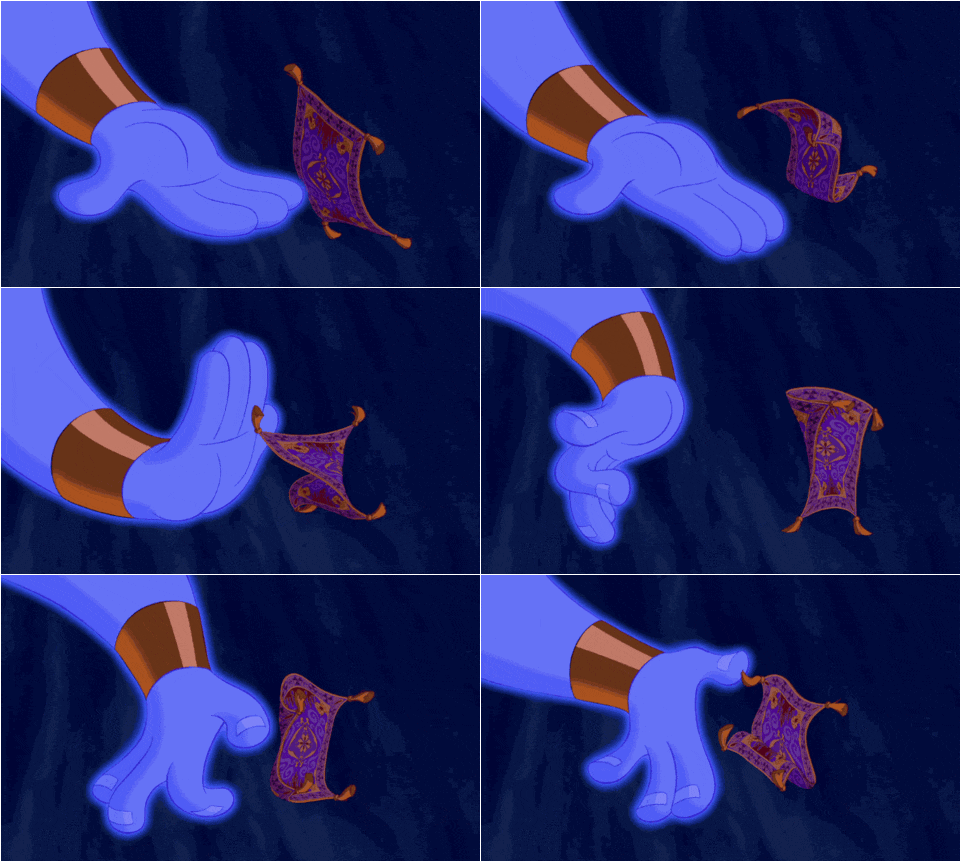
There are some extremely obvious differences between the movie and the original source material for Aladdin. Firstly, as aforementioned, Aladdin is not a random person who is tricked in to retrieving the lamp. He is instead selected by the omnipotent knowledge of the cave as worthy of retrieving said lamp. As well, the Genie and Jasmine see extremely boosted character roles. The Genie, who is now limited to granting three wishes which adds a necessary conflict in Aladdin’s quest, is given a large personality thanks to Robin Williams. There is also only one Genie instead of two. Jasmine, first of all, is given a name. (How progressive) Her character also is centered around her wanting to take control of her own life, and turn away from the objectification of the current laws. What is interesting is that Aladdin, Genie, and Jasmine share a key trait to the story arch: each of them wants what they don’t have. Although Jasmine is rich, she desires the freedom of Aladdin, which is similar to the Genie’s desire for freedom despite being all-powerful. Aladdin, accustomed and tired of the street life, desires to be rich and live in the palace. Jafar becomes the main antagonist of the story. While his character is generally just a bystander, as even his advice to the sultan are brushed off, in the Disney version he is a full-fledged power-hungry maniac, who will stop at nothing until he is all-powerful. This eventually leads to his downfall, as Aladdin utilizes Jafar’s fatal flaw to trap him back into a lamp once he becomes a Genie.
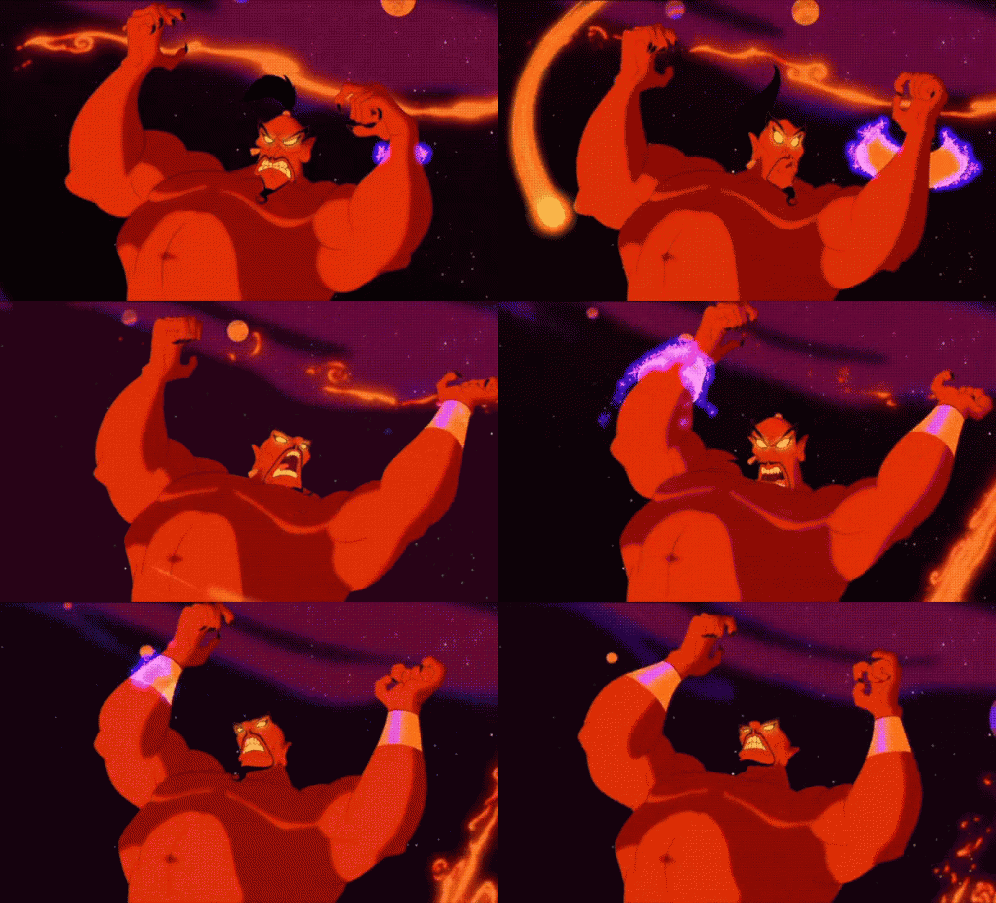
Image result for jafar genie gif

Disney's Aladdin

    After having read an article about the origins of "Aladdin and the Magic Lamp", I found myself scrutinizing the Disney version of Aladdin, to see how the company attempted to portray the Middle Eastern city of Agrabah, and the setting as a whole. I found Disney to be quite blatant and deliberate with the use of phrases, images, ideology, and even characters in order to create a city that appears similar to Disneyworld, but in a Middle Eastern setting and with stereotypes.
    The city of Agrabah itself is clearly intended to represent a Middle Eastern city -- and the image of the city is perhaps a fair depiction of one. Nevertheless, there are many details and references in the movie that come across as stereotypical and shallow representations of the Middle East. For example, in the very first scene, we witness a merchant try to sell a hookah, which ends up not working. While the idea of a merchant is not necessarily stereotypical, the hookah certainly is. The merchant could have been selling any number of items, but the first item he has to offer is a traditionally Middle Eastern tobacco pipe. Here, the city could have been represented in a different way, without playing on the stereotype of Arabic people owning and smoking hookahs. Additionally, on multiple occasions, characters make exclamations to Allah -- either saying "praise Allah" or "by Allah". Nevertheless, there is no other indication of religious faith occurring in the city. Therefore, the inclusion of these phrases seems out of place. In fact, I interpret the lines as quotes that Disney thought a Middle Eastern person might say it. In short, these details, along with others, misrepresent Arabic people and attempts to apply surface level ideas about to Arabic people in order to foster a setting in the Middle East.
    On the other hand, the Genie brings references to Disney and American culture, which caused me to question the true image Disney was trying to create with Agrabah. For example, after Aladdin wins back the love of Princess Jasmine, the Genie attempts to secure his freedom. In the scene, the Genie asks, "Aladdin, you just won the heart of the Princess. What are you going to do next?,"while in the background Disney theme music plays. Although in the context of the movie the genie is prompting Aladdin for a different answer, the line is a clear reference to Super Bowl winners exclaiming "I'm going to Disney world!" -- a tradition that dates back to 1987, a few years before the creation of the movie. As such, it's main purpose in the movie seems to be self-advertising -- as the plot could have been advanced in a similar way without the use of such specific phrasing. Also, as a small note, at the end of the movie, just as he is freed and getting ready for relaxation, the Genie wears a hat shaped like the character Goofy. Although he is a genie and, as such, has access to such a hat, the Disney "product placement" here is unnecessary and creates a confusion given the setting of the movie. Lastly, Disney further manages to muddle the exact image of the city through the Sultan's castle. In my opinion, the castle presented in the movie is strikingly similar to the castle logo that the company uses. While I understand that this point may appear to be a stretch, I justify my opinion based on the previous evidence presented. It is entirely possible that Disney intentionally made use of this detail given that Disney self-promotes in other areas of the movie. Nevertheless, the "Aladdin castle" is not perfectly symmetrical in such a way that the tallest pillar of the castle appears offset in the same direction as the Disney logo. Furthermore, the Aladdin castle has a large archway similar to the Disney castle. Of course, the Aladdin castle, like the rest of the setting of Agrabah is dramatized to appear Middle Eastern, but this idea further proves my point: Disney was vastly more concerned with its own image than it was with accurately representing an Arabian city.


   In short, Disney's use of conflicting American and Middle Eastern images and ideas contributes to the creation of a somewhat magical and unrealistic city -- a city, where some characters have thick (somewhat overly-exaggerated) accents and others sound American. For a while I struggled to determine what to make of my idea about the setting of Aladdin, but I have determined that (obviously) the main goal of the movie was likely revenue -- which accounts for the images of Disney that are dispersed throughout the movie. Furthermore, Disney has a history of misrepresenting minority characters, and the company misrepresents an entire "minority city" through the use of Middle Eastern stereotypes.

Disney's Aladdin

Aladdin is portrayed as much sweeter and smarter in Disney's version than he is in the original story. Aladdin is seen doing selfless acts such as giving his food away to hungry children. His positivity in the opening scene is just one of the many examples of the way Disney "disneyfies" its stories. He is a young boy struggling to eat everyday but yet he is seen with a smile on his face, singing and dancing. Disney almost glorifies the life of a boy who is without family or friends or without enough food to eat. Children watch this opening scene and cannot see the hardship that someone might face who might not actually have a family or enough food.

For how outdated some aspects of the movie is, I think that Disney makes some strides for women in the depiction of women. I mean I could go on and on for days about the sexual dress Disney creates Jasmine to wear, the way Jasmine is being forced to marry and also the horrible scenes in the final few scenes of the movie when Jafar is making her feed him but I do think that within so many horrible depictions of women, there are a few positive ones. I think that the fact that Jasmine goes off into the city by herself shows the strength that she has. While one might say that Aladdin is always saving her, I would contest that the times that Aladdin helps Jasmine are more because Jasmine has never been into the city before and doesn't know her way around rather than her being a helpless girl who can never do anything by herself.
Jasmine always spoke her mind about what she felt. I think one good example of Jasmine's strength is when her father and Aladdin (aka Prince Ali) are talking about marriage, and she overhears them and storms in and tells them how disgusted she is with their behavior. She does not want others to decide her future, and she is very open on expressing this.

Disney freeform

Jasmine is picky, she is not going to marry a suitor just because he is handsome or wealthy, she has standards and values and does not believe that she needs a man just because the law requires it. I think this is very big for Disney as Jasmine shows girls that one should be with a man because they love them and not because they need them to take care of them. Jasmine is smart as well, she is quick to go along with Aladdin's plan when she gets in trouble for stealing the apple, and she is quick to come up with a plan to distract Jafar as Aladdin sneaks in. She is feisty and doesn't like being told what to do and I think that these are important messages for girls to see. While there are many more negative representations of women then there are positive, I think it's important to show the ways in which Jasmine is a positive representation of girls.
Read this to learn more about all the ways Jasmine is one of Disney's best princesses: https://freeform.go.com/funday/news/14-reasons-why-jasmine-was-the-most-inspiring-disney-princess-of-all-time

Disney's Aladdin


As with all Disney versions, there are some cute animal sidekicks. Lago, Jaffar’s parrot, is funny while also cranky. Also Abu is cute as well and seems to be Aladdin’s only friend. When Jaffar dresses like an old man it reminds me of Snow White when the queen transforms into an old lady and is very in line with classic Disney movies. It’s funny how Disney plugs itself with them brief mention of Pinocchio and has Sebastian the crab shows up and mentions Dumbo as well. Also, in the end the Genie is wearing a Pluto hat, which just goes to show how far Disney will go to promote its self.

This gif can be found here.

I think that Aladdin says some interesting things like, “You are only in trouble if you get caught,” which might not be the best for young children to hear and follow. I also thought that there were a lot more magical elements in the movie, like the carpet and Jaffar’s magical abilities. I also could relate to Aladdin when he says, “One day we will be rich and live in a palace and have no problems at all,” since Aladdin and I share the same optimistic thinking. I though that the whole process regarding Princess Jasmine’s suitors was much more progressive than in the short story because it was up to Jasmine to accept one of the princes that showed up on her door steps.

I also like how there is just one main genie, other than when Jaffar is turned into a genie at the end of the movie. I also like how there are only three wishes because it makes Aladdin consider what is important to him and make smart decisions. Even though the genie has all power in the world it’s weird how he only grants each master three wishes, but also if he was freed wouldn’t he still have his magic and be able to grant anyone wishes. I also like how Aladdin is portrayed as a smart and cunning and he and Abu trick their gene to get them out of the lion cave. I also like how Aladdin actually gets to know Jasmine before falling in love with her. I also like how Aladdin is nice and wants to free the genie. I like how Aladdin jumps off of the balcony and gets Jasmine’s attention. I’m glad in the end that Aladdin frees the genie! It just goes to show that doing the right thing can be enough sometimes. It’s also nice that the Sultan changes the law regarding who Jasmine can marry and everyone gets a happy ending except Jaffar.

I also think that it is interesting how Aladdin is the one “chosen one” in this version and doesn’t just have dumb luck, which makes Aladdin seem even more special than he already is. It is also is interesting how the genie has different masters, so Aladdin could just give the lamp to a friend and they could share the wishes that they make. It is also interesting how even though Jaffar is really old he tried to trick the Sultan into making him wed Jasmine if she does not choose a suitor soon.

Disney Aladdin Response

Aladdin’s introduction to Jasmine is thankfully much less creepy than in the original story. Instead of spying on her when she goes to bathe, he comes across her in the market. This introduction also allows viewers to get an initial sense of Jasmine’s personality: she is kind and smart, but also naive of what goes on in the real world. Compared with the original story, Jasmine actually has a personality.

Aladdin maintains the same lack of motivation and direction that exists in the story, but he’s not as “useless” in the film. Aladdin is very clever, and is able to get through life using his tricks and talents. He is also accompanied by Abu - this friendship paints him a lot more positively than in the original story.

Aladdin has clear influences from both the Middle East and South Asia; I originally thought that it purely had Middle Eastern influence. For example, Jasmine’s tiger’s name is Rajah, which is an Indian title meaning “king.” Additionally the story is set in the fictional city of Agrabah and the palace resembles the Taj Mahal - the Taj Mahal is located in Agra. This would also make historical sense, because India did have a Sultan for periods of time in history, and India does have a lot of Muslim and Middle Eastern influence.

The animals in Aladdin have personalities of their own: Iago has such a harsh voice and tone (which almost rings in my ears) which matches his critical, annoyed personality. Iago is also an interesting name choice given that it was probably inspired by Iago, the antagonist of Shakespeare’s Othello. Abu’s voice also stands out, and he also has a very developed personality. He is consistently bothered by Aladdin’s ignorance, but continues to put up with it and stays loyal.

Image result for abu gif disney

The Sultan’s personality is very fitting of his appearance given the track record of Disney movies. His rather rotund shape and exaggerated facial features and attire match his pompous and ignorant yet kind nature. Compared to the Sultan in the story, the Sultan in the film is much more forgiving and weak. He ignorantly listens to Jafar, being literally under his control.

The Disney version takes away all sort of evil nature from the Genie. In the story, the Genie is almost demonic, described as ugly and scary. This Genie is lovable and enthusiastic and is literally blue, a mild non-evil color.

Ultimately, Aladdin’s cleverness leads him to success. He is able to outsmart Jafar, and bring back peace. The fact that Aladdin only has three wishes makes a much more interesting storyline. At the end, when he is faced with the dilemma of freeing the Genie and being a prince, part of my has always been frustrated. When I was a kid, I used to always wonder why he didn’t just wish to make himself a prince, and then give the lamp to Jasmine to wish for the Genie’s freedom. Looking back now, I can see how that wouldn’t have made for a good story.

Disney's Aladdin


    When you first watch the Disney portrayal of Aladdin as a child, the things that stick out are the amazing flying carpet, the strange blue man that lives in a lamp thing, and the protagonist wins by being himself. You do not see the odd occurrences throughout the movie where things seem quite off from reality like when you watch it later when you are older.
    The first thing that stood out was the lyrics for the "Arabian Nights," and how much of the blatant racism I did not catch as a child, such as “It’s barbaric, but hey it’s home.” This trend continues with the accents of the characters in the movie. The so called ‘good’ characters all seem to have an American accent (Aladdin, Jasmine, nice townspeople, etc.) while those who are ‘bad’ townsmen, shop keepers, or guards have an arabic accent. Then, there are the characters that have an english accent like Jafar and the sultan who are both portrayed in a not so good light with one being the conniving villain and the other being the slightly dim witted and easily manipulated. It also is shown through the outfits of the the people in the movie, with the scarcely dressed women (including Jasmine herself), the oddly dressed guards, and the pompously dressed suitor. Each of these portrays different connotations for the characters, and seem out of place in most scenes. This racist tone continues to be seen throughout the rest of the movie and even to the other cultures during the popular song “A Whole New World.”
      Another thing that pops out when watching it again now, is that there is a distinct degrading tone towards women. From the stereotypical fainting when noticed by a guy, to being forced to marry, to even the scene where Jafar has taken over and is now holding Jasmine and her father captive. Each painting women in a not so great light. There are portions of the film that do emphasize that women are smart and capable, such as when Jasmine tricks Aladdin into admitting he was the one from the market or when she pole vaults after him, but these are overshadowed by her ineptness at the market or how many times she needed to be saved in the movie. Plus, keeping in mind that the main issues in the movie seem to stem from Jasmine’s unwilling to marry without love, this portray Jasmine as the cause of the problems. This trend continues as it is Aladdin the ‘knight in shining armor’ that comes to save the day, and magically everything is better, leading to a happily ever after.

     All of this that is apparent to me now paints a whole different view of the movie than before. Instead it is one strife with racism and misogynistic views. Do not misunderstand me, I still enjoy the tale and the animation, but there are major issues that stem from numerous aspect of the movie that I did not catch as a child.

Saturday, March 23, 2019

Disney's Aladdin

Right off the bat, the song about Arabian nights is problematic. “Its barbaric, but hey its home” is quite problematic, however according to this article, the line was worse, but they changed it. Diamond in the rough is a common saying in movie, I wonder what the meaning behind it is, other than someone with good intentions, unlike anyone else- ie Aladdin. It is first said in the very beginning by the merchant. The portrayal of the guards as dim witted is interesting, further emphasizing that Aladdin is quick witted and worthy of being the protagonist. The film makes it very clear that Aladdin only steals to eat, unlike the less worthy thief in the beginning of the movie who is greedy. It is interesting that during Aladdin’s plight to escape he keeps getting the various street performers injured in some way. When Aladdin jumps on rug to escape it is foreshadowing the magic carpet. Aladdin giving the bread to the children is the sign of his pure heart and worthiness. Of course the mother is no longer there any more of either Aladdin or Jasmine, a typical Disney trope. Jasmine wanting to be free is mirrored by her letting out the birds. I like that Jasmine has a tiger, since tigers represent power. The sultan being easily manipulated is similar to the original story, and also contrasts Aladdin’s quick wit and instincts. The ‘love at first sight’ trope is very clearly present when Aladdin first sees Jasmine, interesting because when Jasmine sees the disguised ‘prince’ Ali, she does not fall into that. Aladdin and jasmine are foils in some ways, since Aladdin is free to do as he pleases but is poor and jasmine is not free but very wealthy. Both Aladdin and jasmine’s only friends are their animal. Jafar disguising himself as an old man is very Disney, the villain usually are magical and are able to disguise their appearance, which also reflects the original story.  In fact, mistaken identity is common in this film. Jafar’s ‘golden rule’ is actually quite applicable in real life, since those who are wealthy truly do ‘make the rules’, for themselves at least. The theme of ‘things aren’t always what they seem’ is common in the movie, from the beginning merchant talking about the lamp and Aladdin, and disguised Jafar pointing out the exit from the prison. Wealth is clearly also important in the film, similarly to the fairytale, the cave’s lavish riches are evidence of that. Giving personality to a rug is a very Disney thing to do. I wonder if the concept of a magic carpet originates from this film? Abu is clearly very greedy, perhaps to contrast Aladdin’s lack of greed, as he is always thieving, while Aladdin is usually more noble intentioned. The Sultan actually seems like a decent father, unlike in the fairytale, even though he is naive and easily manipulated. Robin Williams is such a gem. The never had a friend like me song is a little ironic since Aladdin doesn’t really have any friends before this (except Abu). Interesting that Jafar calls Jasmine a shrew, I wonder if this is a reference to Shakespeare's taming of the shrew, where a female character constantly rejects suiters. Freedom is a common theme in the film, both jasmine and the genie want to be free. Of course the happy ending ended up with everything working out for both Aladdin and genie.
Gif