
The Disney Aladdin follows many tropes typical to a Disney
film. Aladdin’s story arch in general is very common across multiple animated
pictures. First of all, Aladdin starts as a poor boy that is deemed to be
nothing by the general population, as seen by his first song about needing to eat
to live and steal to eat. From this he has some innate ability that deems him
worthy of some sort of prize, in this case the ability to go into the cave and
retrieve the lamp. While he is perceived as dirt from the people of his town, his
character supersedes his economic status in the eyes of more powerful forces.
Then after attaining what he desired on his initial quest, he has a realization
that it is not in reality what he wants. While he wanted to win the heart of
Jasmine, he did not want to become sultan when it is brought to his attention.
This can be seen also in Simba’s realization that his life with Timone and Pumba
is worthless in The Lion King. This
leads to another crucial aspect, the hero must suffer a fall from grace in the
eyes of the individuals he holds dearest. Hercules loses Phil, Simba disappoints
Nala, and Aladdin disappoints the Genie.  It is their own pride and hubris that
get in the way of their relationship with their closest friends. However, the
hero redeems himself by saving the people who matter most, and most of all,
making the morally right decision in the end. Again, Hercules decides to stay mortal
with Meg, Simba decides against killing scar (although he dies at his own
hand), and Aladdin eventually frees the Genie. At the end, everyone lives
happily ever after with the love of those around them.
It is their own pride and hubris that
get in the way of their relationship with their closest friends. However, the
hero redeems himself by saving the people who matter most, and most of all,
making the morally right decision in the end. Again, Hercules decides to stay mortal
with Meg, Simba decides against killing scar (although he dies at his own
hand), and Aladdin eventually frees the Genie. At the end, everyone lives
happily ever after with the love of those around them.
It is their own pride and hubris that
get in the way of their relationship with their closest friends. However, the
hero redeems himself by saving the people who matter most, and most of all,
making the morally right decision in the end. Again, Hercules decides to stay mortal
with Meg, Simba decides against killing scar (although he dies at his own
hand), and Aladdin eventually frees the Genie. At the end, everyone lives
happily ever after with the love of those around them.
There are some extremely obvious differences between the
movie and the original source material for Aladdin.
Firstly, as aforementioned, Aladdin is not a random person who is tricked in to
retrieving the lamp. He is instead selected by the omnipotent knowledge of the
cave as worthy of retrieving said lamp. As well, the Genie and Jasmine see extremely
boosted character roles. The Genie, who is now limited to granting three wishes
which adds a necessary conflict in Aladdin’s quest, is given a large
personality thanks to Robin Williams. There is also only one Genie instead of
two. Jasmine, first of all, is given a name. (How progressive) Her character
also is centered around her wanting to take control of her own life, and turn away
from the objectification of the current laws. What is interesting is that
Aladdin, Genie, and Jasmine share a key trait to the story arch: each of them
wants what they don’t have. Although Jasmine is rich, she desires the freedom
of Aladdin, which is similar to the Genie’s desire for freedom despite being
all-powerful. Aladdin, accustomed and tired of the street life, desires to be
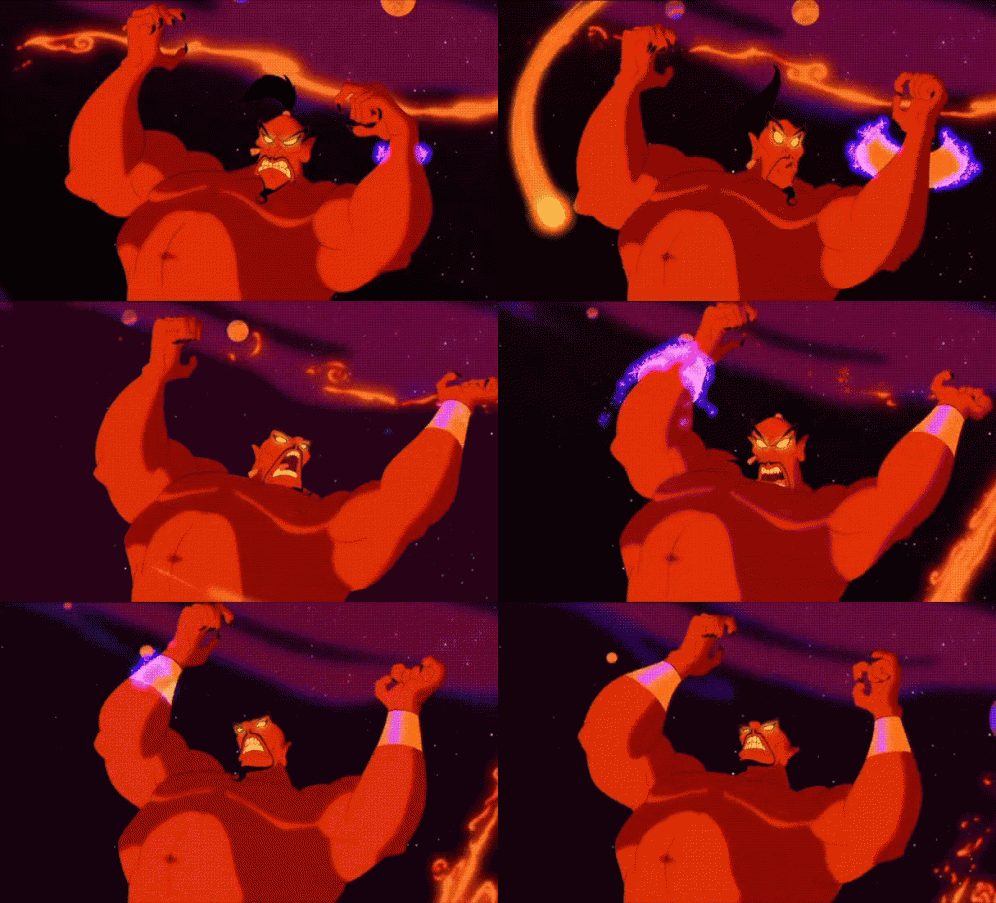
rich and live in the palace. Jafar becomes the main antagonist of the story. While
his character is generally just a bystander, as even his advice to the sultan
are brushed off, in the Disney version he is a full-fledged power-hungry
maniac, who will stop at nothing until he is all-powerful. This eventually
leads to his downfall, as Aladdin utilizes Jafar’s fatal flaw to trap him back
into a lamp once he becomes a Genie.

No comments:
Post a Comment